When octabins make sense
Octabins are often best when:
- you ship one-time or the recipient doesn’t return packaging,
- you store low (1–3 layers), and warehouse space is not a “bottleneck,”
- you don’t want to invest in a fleet and manage return circulation.
Octabins are most commonly used in situations where packaging doesn’t return to the sender or when single-use matters.
A downside often overlooked by production departments: the cost of an octabin is not just the purchase, but also the pallet, fastening materials, assembly time, and often waste.
When mesh containers win – mesh container applications
Mesh containers make a difference when:
- you have regular circulation (regular shipments/returns),
- you count stacking height (5–6 layers makes a huge difference),
- you want to reduce “soft losses”: component damage, downtime, chaotic storage,
- empty packaging transport is costly (folding = fewer trips).
Mesh containers are excellent for storing heavy items such as machine parts or automotive components. They are used across various industrial sectors and perform well in both transport and warehousing. The mesh container models offered are designed with safety and functional use in mind. Our company offers a wide selection of containers that can easily be tailored to individual customer needs.
Mesh containers are successfully used in logistics and warehousing across various industries. Downside: you must manage circulation (inventory, returns, sometimes maintenance/repairs).
Clarifying the numbers (production, warehouse, storage)
Rotations and total cost of ownership (TCO)
In real implementations, octabins typically close at around 5 rotations, while metal containers (metal containers, metal containers) can achieve a minimum of 150 rotations. It’s worth emphasizing the wide application of these containers across various industries, which contributes to their versatility and cost-effectiveness. This changes how costs are calculated: instead of “how much does a unit cost,” you calculate “how much does a cycle cost” and “how much does warehousing and storage cost” on a monthly basis, enabling efficient use of warehouse space. This makes it easier to compare containers of different sizes and different load sizes (preforms, caps, components), and also account for space savings from folding containers after emptying.
Preparation time and operations
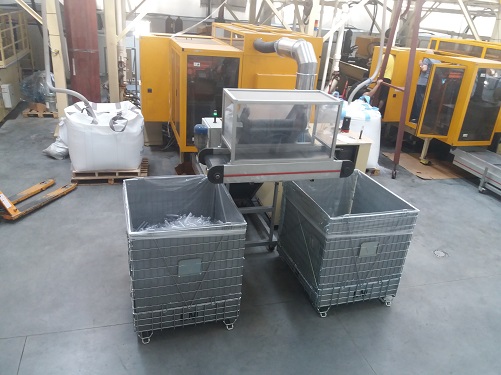
In internal logistics, throughput matters. If containers are prepared “for shipment” several times a day, the difference between several minutes and several dozen seconds becomes measurable in labor hours. In practice, metal containers are designed to be practical: fork pockets, stable stacking, quick folding and container folding, which saves time and space, plus easier cleaning when soiled.
During goods warehousing, containers enable efficient space utilization, translating into better organization and safety in the warehouse.
Their wide application includes logistics and production, where containers perform well in both transport and storage of diverse products.
Stacking and safety
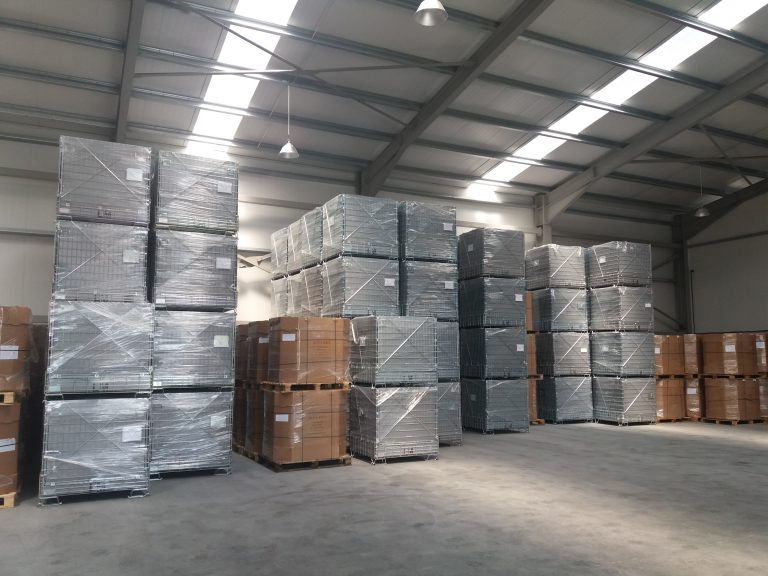
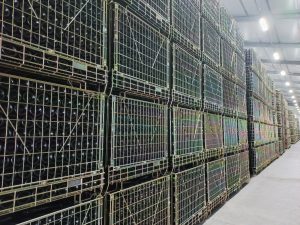
Octabins often end at 2–3 layers. Mesh containers / metal containers (made of steel) allow building stable warehouse stacks, often up to 5–6 layers, while maintaining their safety in compliance with EU standards and the safety of people and goods.
Such durable containers are designed for loads and structural resistance, ensuring their stability in use and resistance to compression and typical mechanical damage. This is important when your goal is efficient goods warehousing, height utilization, and maintaining order in the storage zone.
Mesh containers perform well in warehousing, enabling efficient space utilization and product organization. Their application includes warehouses, production, and logistics, where versatility, safety, and functionality in various working conditions matter.
Empty transport
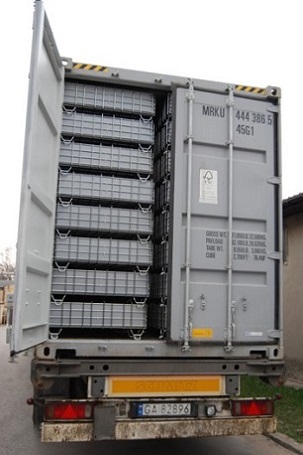
The key here is not the “transporting” itself, but how much space empty containers take up. If containers can be folded, when folded they take up significantly less space, allowing space savings during transport and warehousing. This returns less “air,” and fewer trips mean lower transport costs and less confusion in the warehouse. In practice, this is often one of the largest cost dependencies in closed-loop circulation, especially with goods warehousing and efficient space utilization. Additionally, the application of such containers in logistics and production allows for better process organization and increases flexibility in resource management.
Material and construction: steel, galvanized steel, stainless steel
For PET/preforms, resistance to warehouse conditions and durability matter. Metal containers are most often made of steel (which provides rigidity and durable behavior during stacking). The standard painting color for GITTERBOX containers is gray RAL 7030, emphasizing their aesthetics and compliance with industry standards. Depending on the environment and quality requirements, you’ll encounter:
- galvanized steel – when corrosion protection is important in standard conditions,
- stainless steel – when the environment is more demanding or when enhanced storage hygiene is important.
These containers meet the EPAL standard, guaranteeing their compliance with European standards and transport systems.
There is more than one type of container on the market—they differ in dimensions, capacity, and construction. For buyers, dimensions and capacity are also important: different containers work for PET, others for caps, others for small items in bags, etc.