E-commerce Warehouse Equipment – A Practical Guide from Elkom Trade S.A.
Well-planned e-commerce warehouse equipment is the foundation for efficient operations and fast order fulfillment.
- Metal logistic carriers (mesh containers, roll containers, pallet collars) shorten picking and shipping times and help reduce product damage.
- Reusable logistics solutions can, over time, reduce the costs of single-use packaging by approximately 40% and decrease the number of complaints — depending on the scale and profile of operations.
- Elkom Trade S.A. offers a broad portfolio of logistic carrier designs — from mesh containers and pallet collars to roll containers and picking trolleys.
- Elkom Trade S.A. provides comprehensive support: carrier design, production, service, and regeneration of products.
Why is e-commerce warehouse equipment crucial?
After 2020, e-commerce underwent a dynamic transformation. The value of e-commerce sales in Poland exceeded PLN 100 billion in 2023, with forecasts indicating further growth of 15–20% annually. Customers expect D+1 deliveries, and increasingly, same-day delivery.
An e-commerce warehouse differs fundamentally from a traditional B2B warehouse — instead of large pallet batches, it handles thousands of individual orders daily. This requires equipment that supports:
- fast picking,
- error-free order fulfillment,
- product safety throughout the supply chain.
Optimize your e-commerce warehouse with Elkom Trade
We design metal logistic carriers tailored to real warehouse processes and seasonal volume increases.
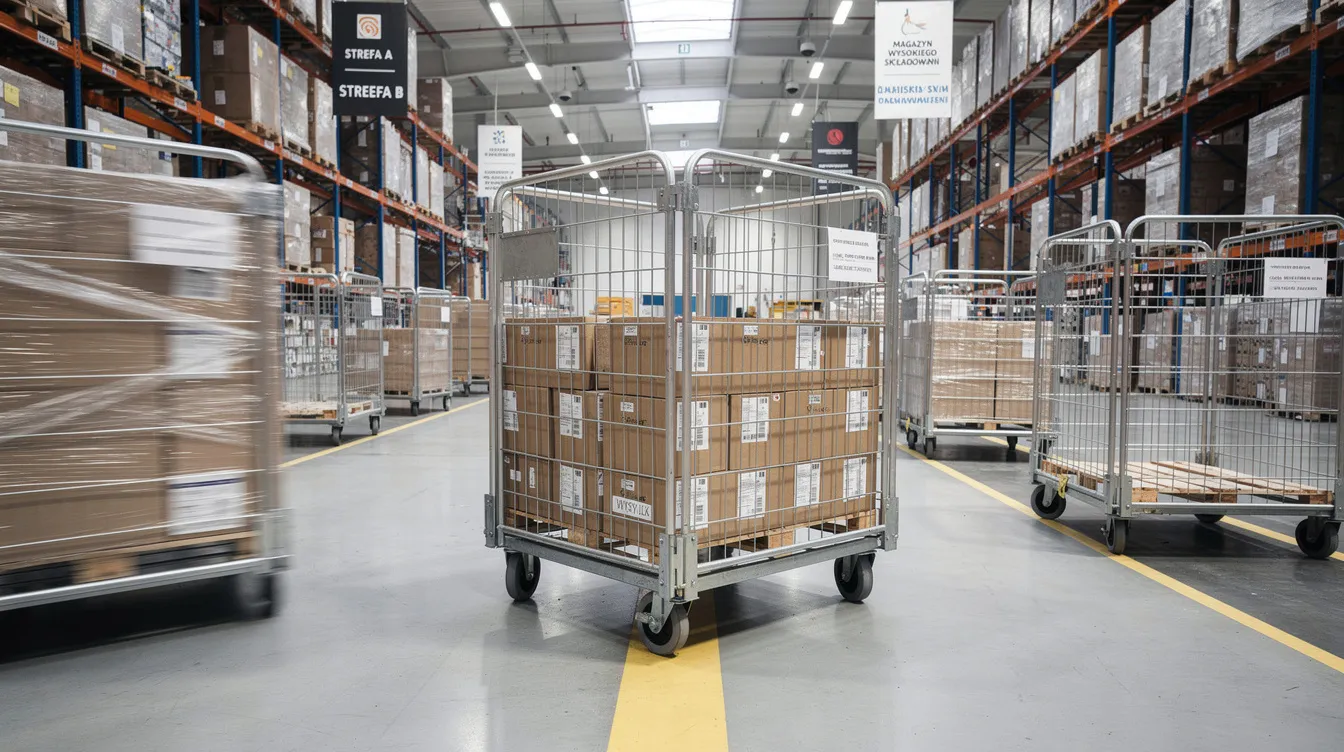
Elkom Trade S.A., as a manufacturer of metal logistic carriers, helps companies plan scalable solutions adapted to real warehouse processes.
Basic e-commerce warehouse equipment – where to start?
Every warehouse needs a solid basic infrastructure. Key elements include:
- Pallet and shelving racks – lower levels as a pallet buffer, upper levels as a pick-face for high-rotation products.
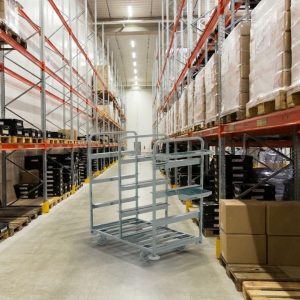
- Warehouse trolleys – platform trolleys (load capacity approx. 200–500 kg) and picking trolleys equipped with shelves or dividers adapted for standard plastic containers, e.g., Euro-standard containers.
- Containers and auxiliary carriers – for sorting and storing goods.
It is advisable to choose modular and reusable equipment so that scaling the warehouse does not require replacing the entire infrastructure.
Metal storage systems for e-commerce – mesh containers, pallet collars, roll containers
More and more e-commerce warehouses are moving away from single-use cardboard boxes in favor of more durable, reusable systems.
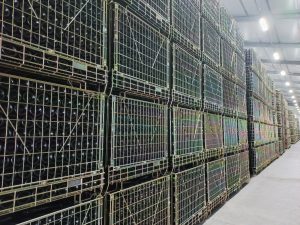
- Mesh containers 1200 × 1000 mm – ideal for storing bulk goods, seasonal products, and returns. Stackability up to 6 units reduces the need for high-bay racking.
- Mesh containers on wheels – a mobile solution for internal transport, handling returns, and picking.
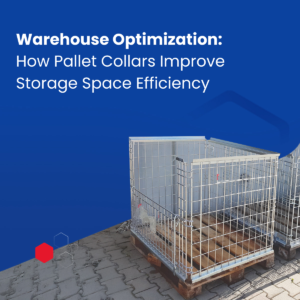
- Stackable pallet collars (mesh structures, height approx. 800–1200 mm) create flexible “mini-racks” on Euro pallets with a load capacity of up to approx. 1000 kg — without investing in permanent structures.
Mobility in an e-commerce warehouse – roll containers and picking trolleys
In e-commerce, the rule is: “the goods come to the person”.
Roll containers (2-, 3-, or 4-sided, including anti-theft models) are used for:
- transporting packages to the loading ramp,
- transporting returns,
- order picking in high-volume zones.
Elkom Trade order picking trolleys, equipped with shelves, dividers adapted for Euro containers, or a simple platform, facilitate the organization of transported goods, help reduce picking errors, and increase work efficiency.
Optimize your e-commerce warehouse with Elkom Trade
We design metal logistic carriers tailored to real warehouse processes and seasonal volume increases.
Organization of picking and packing – containers, carriers, and accessories
The key process in e-commerce is the picking of individual orders.
The most important elements:
- Euro-standard containers (e.g., 600 × 400 × 280 mm, stackable 5/1),
- Mesh containers with dividers – separation of assortment and reduction of errors (under favorable conditions, even to below 0.1%),
- Collapsible mesh containers – ideal for returns and seasonal surpluses; when folded, they occupy approx. 20–30% of their original volume.
Proper labeling (RFID, descriptive plates) can speed up work in the shipping zone by as much as approx. 20%.
Automation and IT systems in an e-commerce warehouse
The success of e-commerce depends not only on physical carriers. IT systems (WMS, ERP, integrations with marketplaces) are crucial for inventory management.
Implementing scanners, mobile terminals, pick-by-light, and pick-by-voice can shorten picking time by 20–30% — with proper process organization.
When automating, it is important to select carriers compatible with transport lines and AGVs. Elkom Trade designs mesh containers with standard dimensions for AGVs, analyzing, among other things:
- picking time,
- number of errors,
- space utilization.
E-commerce warehouse equipment vs. seasonality and volume growth
Order peaks, such as Black Friday, can increase volume by 300–500%.
Solutions:
- Collapsible mesh containers and pallet collars – increase storage capacity by 40–60%.
- Mobile racks and additional roll containers – maintain shipping fluidity.
- After the season, carriers can be folded and stored, not occupying space.
Elkom Trade also offers product regeneration before subsequent seasons.
E-commerce warehouse equipment costs and investment planning
Cost depends on warehouse scale, automation, and personalization. Below are approximate costs for comparable batches of carriers:
- Warehouse trolleys: approx. PLN 500–1500/unit.
- Mesh containers: approx. PLN 800–2500/unit.
- Roll containers: approx. PLN 800–2500/unit.
- Custom-designed solutions: approx. PLN 3000–10 000/unit.
Costs are influenced by factors such as coating type, steel thickness, additional options, and customer-specific design requirements.
Phased purchase strategy:
- Racks and trolleys (approx. 30% of budget),
- Mesh containers and pallet collars (approx. 40%),
- Automation and IT systems (approx. 30%).
Elkom metal carriers have a lifespan of approx. 10–20 years and a residual value of up to 50%, which can reduce TCO by approx. 30%.
Selection of equipment based on assortment profile
- Small products (cosmetics, electronics): – mesh containers with fine mesh (approx. 50 × 50 mm openings), – containers with dividers.
- Bulky products (furniture, household appliances): – pallet collars, – large containers without divisions.
- Sensitive goods (food, chemicals): – mesh containers with additional filling approved for food contact, – containers with coatings allowing for easy washing and disinfection.
A warehouse process audit conducted by Elkom Trade specialists can increase efficiency by 20–40%.
Safety, ergonomics, and sustainable development
Modern logistic carriers should ensure:
- no sharp edges,
- stable construction,
- brakes and door locks,
- clear marking of maximum load capacity in accordance with good OHS practices.
Ergonomic work organization (e.g., loading height approx. 900 mm) can reduce employee strain by up to 70%.
Sustainable development is not just data in reports. Reusable metal carriers (1000+ cycles) reduce waste by 80%. Elkom Trade uses materials that are recyclable to the greatest extent possible, which limits the negative environmental impact of waste.
Summary – how to plan e-commerce warehouse equipment with Elkom Trade S.A.?
An efficient e-commerce warehouse requires:
- Analysis of volumes and assortment,
- Process audit,
- Warehouse zone design,
- Selection of appropriate carriers and additional equipment,
- Implementation with employee training,
- Regular optimization.
Starting cooperation with Elkom Trade S.A. allows for the selection of the optimal carrier for goods transport and storage. Thanks to many years of experience in the metal carrier industry, we help assess whether the use of metal carriers will optimize warehouse processes and be the best solution for a given assortment and working conditions.
The company provides not only mesh containers, roll containers, and pallet collars but also designs carriers according to client requirements and offers service, regeneration, and cleaning — supporting the continuity of warehouse operations for years.
Submit Form
FAQ
Appropriate steel protection and the selection of the right coating or additional filling allow containers to be used for storing food in individual packaging, in accordance with HACCP requirements. For chemicals and sensitive products, solutions enabling easy washing and disinfection are chosen.
With proper use, metal carriers can last 10–20 years. Product regeneration (repairs, component replacement, coating refreshment) is usually 60–70% cheaper than purchasing a new carrier.
Modular systems — pallet collars, collapsible mesh containers, trolleys with interchangeable shelves — allow for quick warehouse reorganization.
The returns area should be equipped with mesh containers that allow for sorting. Collapsible containers facilitate space management — during periods of fewer returns, they can be folded. Proper labeling reduces the risk of errors by up to 50%.