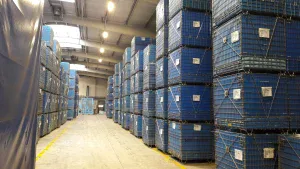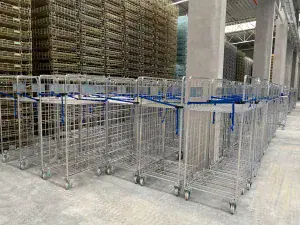
An increase in orders in the beverage industry means a greater burden not only for PET preform production lines. During periods of increased demand, warehouses, packing areas, internal transport, and the entire delivery system to customers also operate more intensively.
Even well-planned production can be slowed down if there are no empty containers at the line, finished preforms take up too much space in the warehouse, or carriers do not return from customers in time.
Therefore, preparation for the season should include not only production capacity and raw material stock, but also an analysis of the number of containers, their rotation time, and the method of storing PET preforms.
Why Is Unit Price Alone Not Enough?
Two containers of similar dimensions may have different load capacities, durability, coatings, and functionalities. A more expensive model can operate longer in circulation, better protect the product, and generate lower operating costs.
Price requires a broader analysis, especially when containers are in continuous rotation, transported between facilities, handled by forklifts, stacked, washed, or used in humid environments for many years.

- Check if you are truly comparing the same product
A similar name or approximate dimensions do not mean that products are equivalent. First, you should compare:
- external and internal dimensions,
- tare weight and usable capacity,
- diameters of wires, profiles, and tubes, as well as mesh density,
- design of the base, walls, and locking mechanisms,
- type of bottom and additional safeguards,
- foldability and stackability.
Internal dimensions are particularly important. Containers with the same external dimensions may hold a different number of products, which, on a large scale, affects the number of transport cycles, warehouse utilization, and fleet operating costs.
In addition to structural parameters, it is worth assessing the quality of workmanship — the quality of welds, joints, edge finishes, and component fit (e.g., on a trial batch). These details affect user safety, structural stability, and the time of trouble-free operation.
A greater number of wires or a higher container weight does not always mean higher strength. Key factors are structural parameters, load transfer method, container geometry, and manufacturing quality. Container weight also affects transport costs, which is significant for frequent rotation over long distances.
- Distinguish Load Capacity from Stacking Capability
Container load capacity and permissible stacking load are two different parameters. The ability to transport a certain weight does not automatically mean that several full containers can be safely stacked one on top of another.
The offer should clearly specify:
- maximum container load capacity,
- permissible number of layers when stacking,
- maximum load on the bottom container or maximum container load capacity at a given stacking height,
- rules for stacking empty and full containers.
Lack of this data makes it difficult to assess safety and can lead to improper container use.
- Compare the Quality of Anti-Corrosion Protection
The type of coating should match the working environment. Different protection will suffice in a dry warehouse, while another will be needed in a cold room, outdoors, with frequent washing, elevated humidity, near the sea, or in contact with corrosion-accelerating substances.
When comparing offers, you should check:
- type of galvanization or other coating,
- declared thickness of the protection,
- application of passivation or additional sealing and the coating’s resistance to plant conditions,
- method of protecting welds and moving parts.
A cheaper coating may be sufficient in mild conditions, but in a demanding environment, inadequate protection will shorten the container’s service life.
- Assess the suitability of the container for the client’s process
The best container is not a design with the most features, but a solution tailored to a specific process. It is worth determining:
- what will be stored and what is the weight of a single load,
- how the product is loaded and unloaded, and whether access to it is needed during stacking,
- what equipment will transport the container and whether it integrates with the production line,
- how often it will be folded, opened, and moved,
- whether it requires stabilizers, dividers, or additional product protection.
A container may meet basic technical requirements yet still hinder work. A flap placed too high, an inconvenient latch, or an ill-fitting base can prolong handling and increase the risk of damage.
Depending on the process, different parameters will be crucial – for some, usable capacity will be most important, for others, load capacity, and for still others, foldability or compatibility with automation, or the ability to easily replace damaged parts in-house. A thorough comparison requires defining priorities based on actual use.
For companies operating in the EU, it is worth verifying the container’s compliance with current PPWR (Packaging and Packaging Waste Regulation) requirements. Non-compliance can generate additional costs, operational limitations, or the need to replace the fleet in the future.
Are you comparing two container offers and don't know which one to choose?
We will help you evaluate the parameters, durability, logistics, and total cost of ownership for both solutions.
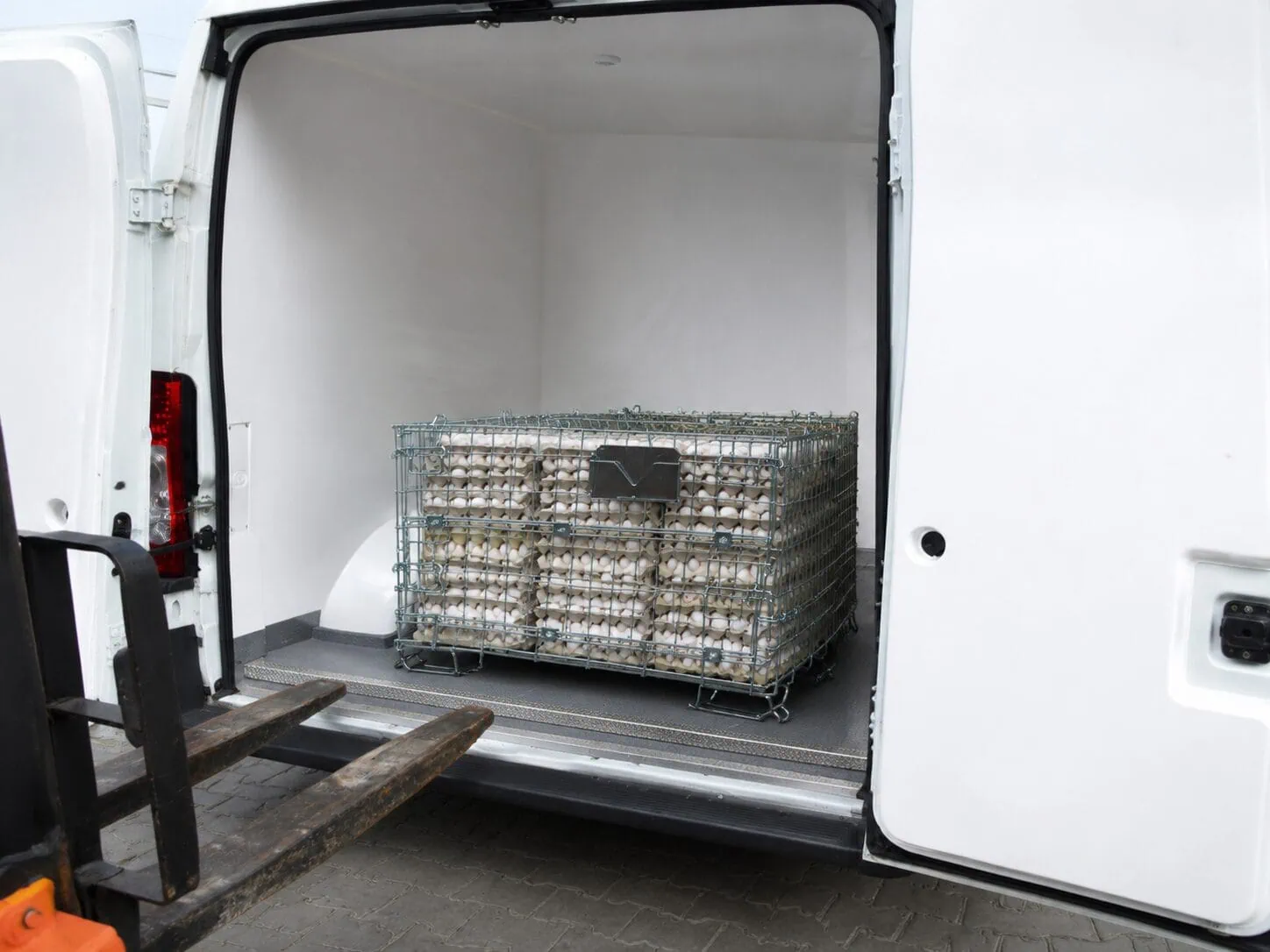
- Check how many containers fit in transport
Unit price should be analyzed together with logistics costs. Important factors include:
- foldability and transport package height,
- number of units that fit on a truck or in a container,
- cost of delivery per unit and space needed to store empty containers.
A container that is a few percent cheaper may generate higher costs if fewer units fit in a single transport. For continuous rotation, not only the first delivery but also subsequent logistic cycles should be calculated.
- Assess the Durability of the Most Wear-Prone Components
The most wear-prone components are:
- hinges, latches, and guides,
- feet, stacking corners, and base,
- contact points with forklift forks,
- wheels, brakes, and product stabilizing elements.
It is worth checking whether the design has been tested under conditions similar to actual use and whether it is based on experience from similar implementations.
- Check Repair and Refurbishment Options
The container should also be evaluated for operational damage. When comparing offers, it is worth determining:
- whether spare parts are available and individual components can be replaced,
- whether the structure is suitable for welding and straightening,
- whether the manufacturer offers refurbishment and if the container can return to service after it,
- whether damage to one wall or base requires the entire container to be withdrawn.
An easy-to-repair design can lower fleet maintenance costs. A low initial price without access to parts and refurbishment often means faster container replacement.
Beyond the possibility of repair itself, it is worth assessing whether the container regains its original performance parameters after refurbishment and whether the cost of refurbishment is justified compared to purchasing a new container.
It is also important whether spare parts are readily available, at what price, and within what timeframe they can be delivered. The repeatability of parts manufacturing and their quality consistency with the original container affect the safety and profitability of self-repairs.
- Compare the Scope of Documentation and Technical Support
The offer should include not only the product name and price, but also:
- technical drawing and confirmation of key parameters,
- usage and stacking instructions, and information on materials and coating,
- possibility of prototyping and testing before serial production,
- engineer support, warranty conditions, and damage reporting procedure.
It is worth paying attention to the availability of technical support — response time, scope of assistance, and the possibility of consultation for repairs, damage assessment, or refurbishment planning. Quick contact with the manufacturer can significantly reduce fleet downtime.
Access to instructions for use, operation, stacking, and repairs is of great value. The response time to inquiries and the scope of after-sales and post-warranty support are also important – especially for large container fleets.
- Consider Delivery Time and Order Fulfillment Capability
Price loses significance if containers are not delivered by the required deadline. It is necessary to verify:
- prototype completion time and documentation approval,
- serial production time and the possibility of fulfilling orders in batches,
- material availability and supplier production capacity,
- pickup and transport conditions.
Delays can cause downtime, production limitations, or the need for temporary packaging. These costs should also be considered.
- Calculate the Total Cost of Ownership (TCO)
TCO, or Total Cost of Ownership, covers the entire service life of the container. The calculation should include:
- purchase price and transport from the manufacturer,
- internal transport costs, capacity, and number of containers needed,
- cost of storing empty fleet and estimated service life,
- repairs, spare parts, and refurbishment,
- losses due to product damage and the cost of withdrawing and replacing worn-out containers.
The cost of container disposal at the end of their service life should also be added to the TCO. Depending on the material, design, and local regulations, these costs may vary and affect the profitability of the entire investment.
A more expensive container may prove more advantageous if it holds more product, reduces damage, decreases the number of transport cycles, remains in service longer, or is suitable for refurbishment.
Practical Checklist for Comparing Offers
Before choosing a supplier, it is worth compiling both proposals in a single table.
The table will quickly show whether a lower price is a real advantage or results from a limited product and service scope.
Area | Elkom Trade Mesh Containers | Offer B |
Unit Price | ||
Internal Dimensions | ||
Usable capacity | ||
Container weight | ||
Usable Capacity | ||
Container Weight | ||
Load Capacity | ||
Stacking Full Containers | ||
Stacking Empty Containers | ||
Coating Type and Thickness | ||
Number of Units in Transport | ||
Cost of Transport per Unit | ||
Availability of Spare Parts | ||
Refurbishment Option | ||
Warranty | ||
Lead Time | ||
Engineer Support |
Prototyping Option
Estimated Service Life
The Cheapest Offer Is Not Always the Most Favorable
You should not always choose the most expensive container. Reinforcements and advanced protections only make sense if they match the working conditions.
The most favorable offer provides the required level of safety, durability, and functionality without elements that do not add value. What matters is the lowest cost of process operation over the entire service life, not just the lowest purchase price.
Need to compare available solutions?
In your request for quotation, it is worth describing the product, required load capacity, handling method, environmental conditions, stacking, and transport. This allows for comparing solutions that truly correspond to the same application.
The Elkom Trade team analyzes the usage process and total operating costs of containers. Based on this, we propose a standard, modified, or custom-designed solution for a specific product and process.

Author: Kamil Chamerski
Product Manager · Elkom Trade
An expert in the development of products and logistics solutions for manufacturing, industrial, and warehousing companies. He combines client discussions, process analysis, and the design of functional solutions that help optimize logistics, improve work ergonomics, and increase operational efficiency.