1. Start with the process, not the dimensions of the roll container
One of the most common mistakes when choosing warehouse equipment is starting with product parameters: dimensions, number of sides, or maximum load capacity. Meanwhile, the first step should be an analysis of how daily warehouse operations are conducted.
It is worth answering a few basic questions:
- Does the employee pick one order or several simultaneously?
- Do products go directly into the roll container, or first into smaller containers?
- What are the weight, dimensions, and susceptibility of goods to damage?
- How long is the route the carrier travels during one operation?
- Will the roll container be used exclusively within the warehouse, or also for transport to customers? Will it also be used in store aisles?
- How often will the carrier be loaded, unloaded, and moved?
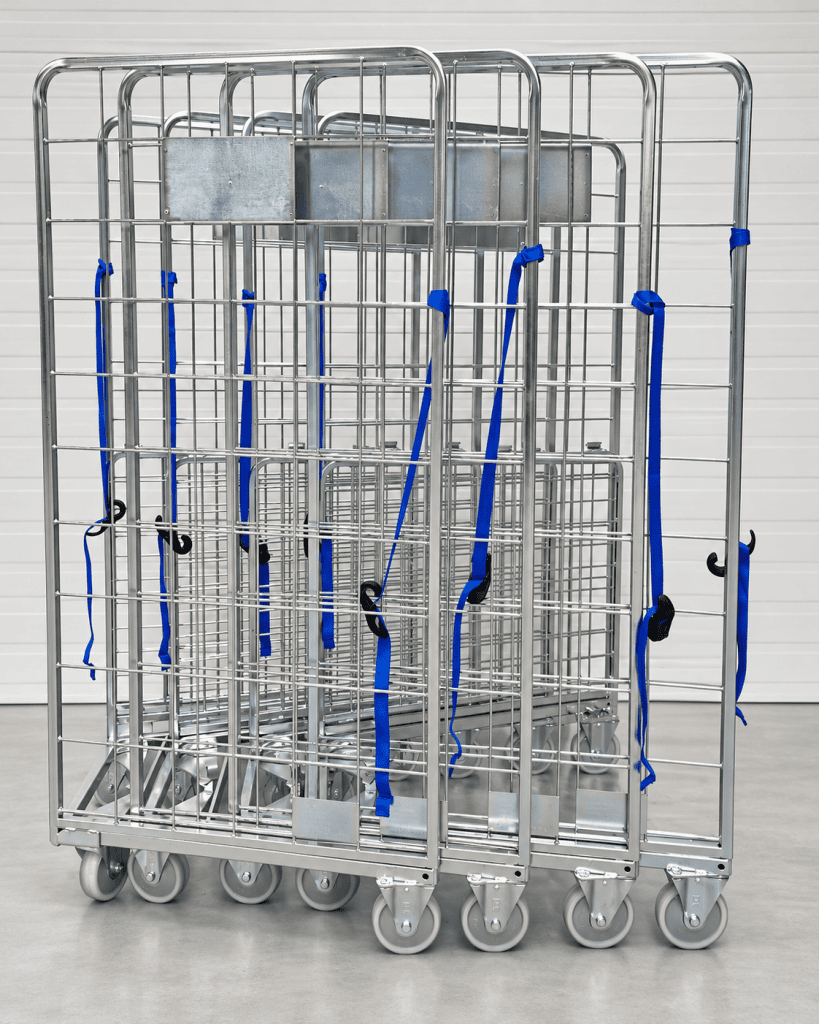
The answers help determine which structural features are truly significant. For example, a warehouse handling many small online orders may need a trolley with several picking levels. In contrast, a distribution center picking larger batches of goods for stores may make better use of roll containers with greater load space, equipped with securing straps.
A well-chosen carrier should match the warehouse’s workflow, rather than requiring the process to adapt to its design.
2. Two-sided, multi-sided roll container, or trolley with shelves?
Various designs of mobile warehouse carriers are available on the market. Their functionality primarily stems from the method of access to the load, the level of security, and space organization.
Two-sided roll containers – quick access to products
Roll containers with two side walls allow convenient access to transported goods. They are primarily suitable where quick loading, unloading, and transport of regularly shaped products are essential.
They can be used, among other things, for:
- moving cartons and bulk packaging,
- handling store deliveries,
- transporting products between warehouse zones,
- transporting goods requiring frequent access.
However, it should be remembered that the open design requires adequate load securing, especially when moving products of irregular dimensions.
Multi-sided roll containers – greater load control
Three- and four-sided designs provide additional restriction of product movement outside the load space. They are particularly useful when transported goods vary in size, there is a risk of them shifting during transport, or additional content security is needed.
Depending on the design, a roll container can be equipped with opening walls, doors, securing straps, or other elements to facilitate handling.
Picking trolleys with shelves – organizing multiple orders
Not every picking process requires a classic roll container with a large load space. In warehouses where an operator simultaneously collects products for several orders, the ability to organize and separate them may be more important.
Picking trolleys equipped with shelves or spaces for transport containers allow individual zones of the trolley to be assigned to specific orders, product groups, or work stages.
Such a solution is particularly interesting for e-commerce, spare parts warehouses, distributors of small components, and logistics centers handling multi-item orders.
3. Roll container dimensions – why bigger isn’t always better?
When choosing a roll container, it’s easy to focus on maximum capacity. Larger load space can mean the ability to transport more goods in one trip. However, this does not always translate into higher efficiency.
A roll container that is too wide can hinder movement in warehouse aisles. One that is too high can limit access to products or make it difficult to control the load. In turn, poorly chosen length can complicate maneuvering in areas with limited space. When determining dimensions, three areas should be considered.
- Warehouse space. Aisle width, turning radii, passages, gates, elevators, and workstation dimensions define the actual limitations for the design.
- Product characteristics. The dimensions and weight of transported goods affect the required usable space and the method of load arrangement.
- Transport organization. If roll containers will also be used outside the warehouse, their compatibility with vehicle load spaces, loading equipment, and unloading conditions should be checked.
In practice, the proper selection of dimensions should be based on the entire route of the roll container, not just the place where it will be loaded
4. Wheels – one of the most important structural elements
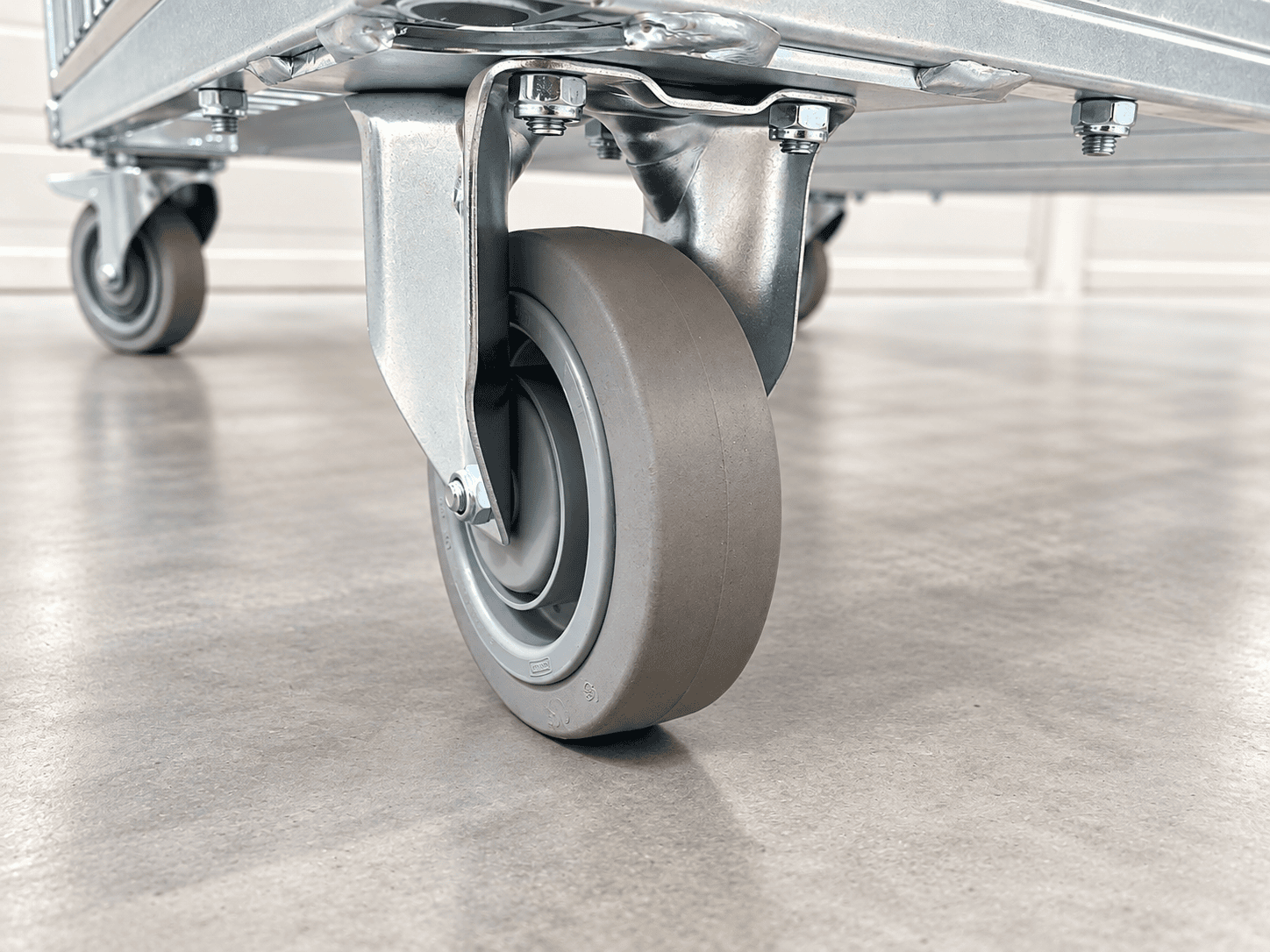
Wheels directly affect the maneuverability, rolling resistance, stability, and ease of handling of the roll container. Their selection should take into account the weight of the transported load, the type of surface, the length of the route, and the frequency of maneuvering.
What to consider when choosing wheels for a roll container?
- Wheel diameter. Larger wheels can facilitate overcoming small unevenness and reduce rolling resistance under certain conditions, but they must be adapted to the carrier’s design.
- Tread type. The wheel material should be adapted to the surface, required grip, permissible noise level, and operating conditions.
- Wheel arrangement. The use of swivel and fixed wheels affects the behavior of the roll container during travel and maneuvering.
- Brakes and locks. Depending on the process, solutions preventing uncontrolled movement of the carrier during standstill may be necessary.
It is particularly important to check how the roll container behaves with an actual load. A model that moves easily around the warehouse when empty may require completely different effort when working with a full load. Therefore, when assessing ergonomics, it is worth conducting a test on a real transport route.
We will analyze your order picking method, the type of products transported, and working conditions. We will propose a standard roll container or a dedicated solution tailored to your warehouse's needs.
5. Shelves, dividers, and straps – equipment that impacts picking efficiency
The carrier’s design is one thing, but equally important is how its usable space is organized. In warehouses handling a diverse assortment, a standard, undivided load space does not always allow for efficient work.
- Shelves – better space utilization and product protection. Shelves allow goods of different sizes to be separated and reduce the need to stack products directly on top of each other. This can reduce the risk of damage to delicate packaging and facilitate access to individual order items. When choosing them, not only the number and arrangement, but above all the permissible load of each shelf and the available height between levels are important.
- Dividers – organizing multiple orders. If an operator picks several orders during one trip, proper space division helps maintain order and reduce the risk of mixing products. Depending on the process, dividers, separate transport containers, or dedicated storage areas can be used.
- Straps and securing elements – stability during movement. When transporting bulk packaging, cartons, and irregularly shaped products, securing them against uncontrolled movement is important. Straps, crossbars, and appropriately designed walls can improve the stability of the transported load, provided they are used correctly and adapted to its characteristics.
The most elaborate design is not always the best. What matters is the functionality of the elements actually used in a given process.
6. Foldable or monolithic roll container
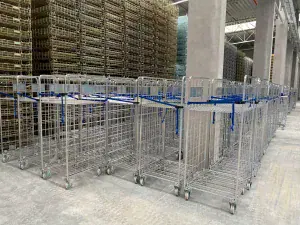
When choosing a roll container, it is worth considering not only the transport of full units but also how empty carriers are handled. In large retail chains, distribution centers, and warehouses handling regular deliveries, the number of empty roll containers can be significant.
V-nesting design
V-nesting roll containers allow empty carriers to be nested, thereby reducing the space they occupy during storage and return transport. This solution is worth considering especially when empty roll containers regularly return from delivery points or warehouse space is limited.
Monolithic design
Monolithic roll containers have a fixed structure, which can be beneficial in processes requiring a specific arrangement of shelves, securing elements, or repeatable space organization. Their selection should be considered when the carrier is intensively used in one facility, and the ability to fold does not provide a significant operational benefit.
The most important question is not which design is better, but whether the roll container will work more often with a load or also regularly return empty.
7. What solutions does Elkom Trade offer?
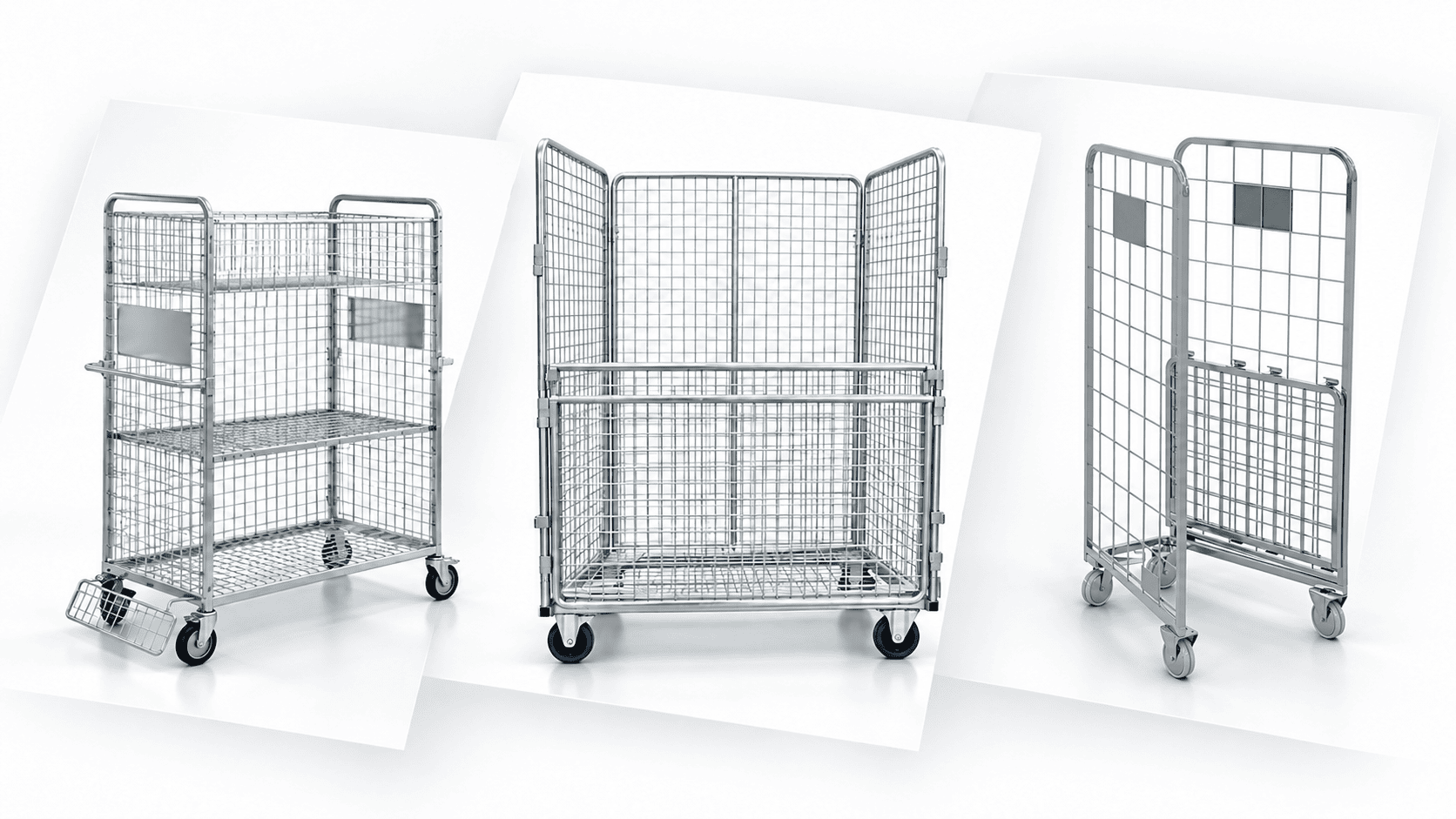
Elkom Trade designs and manufactures metal logistics carriers in Poland for various warehouse and distribution processes. The portfolio includes both roll containers for internal transport and trolleys designed for order picking. We produce both foldable and monolithic, two-sided and multi-sided roll containers. If you cannot find a suitable solution in our portfolio, we design individual solutions tailored to the client’s process.
Below we present three exemplary designs with different functions.
8. The cost of a roll container is not just the purchase price
When choosing warehouse equipment, it is worth looking at the cost over the entire period of use. Two roll containers of similar dimensions and load capacity may differ in design, durability of running gear components, servicing possibilities, and the method of organizing return transport.
The total cost of ownership (TCO) is influenced by, among other things, purchase, maintenance, repairs, replacement of worn components, transport, and the way the carrier is used. For metal structures, the possibility of refurbishment is also important. Replacing wheels, repairing structural elements, or restoring equipment functionality can, in appropriate cases, extend the roll container’s service life.
Therefore, when comparing offers, it is worth considering not only the cost of a single carrier but also its anticipated intensity of use and maintenance costs.
9. Checklist – 8 pieces of information worth preparing before inquiring about a roll container
Before speaking with a manufacturer, it is worth gathering basic information regarding the planned application.
- Type, maximum weight, and dimensions of transported goods.
- Number of orders or units handled during one cycle.
- Conditions and location of carrier use.
- Dimensions of aisles, passages, elevators, and work areas.
- Type of flooring, thresholds, and other obstacles along the route.
- Required number of walls, shelves, dividers, and securing elements.
- Method of storing and transporting empty carriers
- Planned number of roll containers and frequency of use
Such prepared data allows the manufacturer to quickly assess whether a standard solution will meet the company’s needs or if an individual design will be required.
9. The best roll container is the one that fits the process
Roll containers can support efficient order picking, internal transport, and distribution, but their effectiveness primarily depends on properly matching the design to the operating conditions.
The number of walls, shelf arrangement, wheel type, dimensions, and foldability should result from the characteristics of the products and the organization of warehouse work.
It is therefore worth looking at a roll container not as a single piece of equipment, but as part of the entire logistics process.
A well-designed carrier does not just transport products. It helps reduce unnecessary operations, organize material flow, and better utilize warehouse resources.

Author: Kamil Chamerski
Product Manager · Elkom Trade
Expert in product development and logistic solutions for production, industrial, and warehouse companies. Combines client conversations, process analysis, and design of functional solutions that help optimize logistics, improve work ergonomics, and increase operational efficiency.