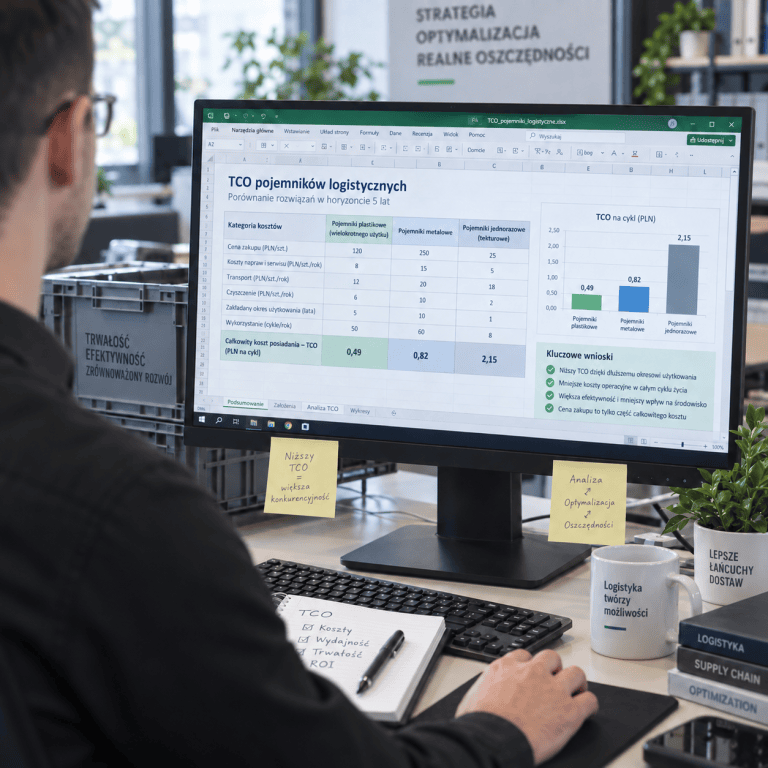
When choosing a supplier for logistic containers, many companies begin their analysis by comparing the purchase price. This is natural – the first invoice represents the most visible cost.
For imported solutions, especially those from distant production markets, the unit price often appears very attractive. However, the purchase price is only one element of the Total Cost of Ownership. The true analysis only begins when all costs associated with operating the fleet over subsequent years are considered.
What costs does the TCO analysis of logistic containers include?
TCO (Total Cost of Ownership) analysis allows for viewing the purchase of logistic containers from the perspective of the product’s entire lifecycle. For reusable containers, the actual cost does not end with the delivery of the first batch. The Total Cost of Ownership is influenced by both initial investment costs and expenses related to the subsequent use of the fleet.
How to calculate the actual cost of a reusable container fleet?
Modern industrial logistics increasingly requires companies not only to optimize processes but also to consciously manage costs. In the case of reusable logistic containers, the purchasing decision for many years was often based on a single criterion:
the purchase price per unit.
However, this approach is insufficient. A logistic container is not a single-use product. It is an element of a company’s transport infrastructure that operates for many years in a closed or semi-closed logistic loop.
During this time, it is:
- repeatedly transported,
- stored,
- used in production,
- repaired,
- regenerated,
- replaced.
Therefore, the actual cost of a solution does not result solely from the initial price. The answer to the question: “What is the true cost of a given fleet of logistic containers?” is the analysis of TCO – Total Cost of Ownership.
What exactly is TCO (Total Cost of Ownership)?
TCO (Total Cost of Ownership) is a cost analysis method that reveals the full cost of a given solution over its entire period of use. Unlike traditional offer comparisons, which focus primarily on the purchase price, TCO considers all costs associated with the product’s operation. For reusable logistic containers, this means analyzing the entire product lifecycle:
- from the purchase of the initial fleet,
- additional costs upon purchase such as transport, customs duties,
- through usage,
- maintenance,
- repairs,
- replacements,
- up to the end of its operational life.
This is precisely why a solution that is more expensive initially often proves to be more economical over its entire lifespan. TCO analysis is increasingly applied in the industrial packaging sector, as the actual cost depends not only on the product price but also on transport, storage, handling, damage, and reusability.
Why doesn’t the container purchase price show the total cost?
Let’s consider a simple example. A company needs 1000 logistic containers.
- Supplier A offers a container for 90 euros per unit.
- Supplier B offers a container for 140 euros per unit.
At the level of the initial calculation:
- solution A appears more favorable,
- the initial investment is lower,
- the purchasing decision seems obvious.
However, the containers will be in use for years to come.
Therefore, additional questions need to be answered:
- What will be the cost of delivering the fleet?
- How often will the containers require replacement?
- Can damaged components be repaired?
- What is the availability of spare parts?
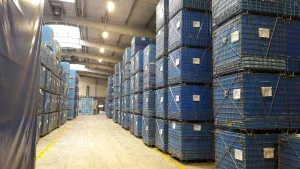
- How much space do they occupy during storage?
- What additional costs will arise during use?
Only the sum of all these elements reveals the true business cost.
What elements does the TCO analysis of logistic containers include?
For a fleet of reusable containers, TCO analysis should encompass all costs that impact the solution’s operation throughout its lifecycle. Our Experts, who specialize in optimizing logistics processes and collaborating with our clients, analyze not only the purchase price but also costs related to delivery, usage, maintenance, and fleet replenishment.
A comprehensive TCO analysis of logistic containers includes, among other things:
- Initial CAPEX – the actual cost of fleet acquisition
The first element is the cost of initiating the investment. However, CAPEX should not be understood solely as the catalog price of the container. The actual entry cost into the system includes:
- the purchase price of the container,
- transport,
- import costs,
- customs duties,
- additional delivery-related fees.
This is particularly important for purchases made from distant markets. The production price is not always the final price for the enterprise. Therefore, in TCO analysis, one should compare not:
the product price at the manufacturer
but:
the actual cost of delivering the ready fleet to the user.
- Cost of container replacement
Every logistic fleet requires replenishment during its operational life. Containers may become:
- damaged,
- withdrawn from service,
- lost,
- worn out after a certain number of cycles.
Therefore, TCO should account for the cost of subsequent purchases.
The cost of replacement includes:
- the price of a new container,
- transport,
- import costs,
- delivery waiting time.
The more frequently units need replacement, the greater the impact of this element on the total fleet cost.
- Cost of regeneration and repairs
One of the most important features of a good reusable solution is its ability to be kept in circulation. Regeneration helps limit the need to purchase new units and extends the product’s life.
TCO analysis should include:
- the cost of regeneration,
- the cost of repairs,
- the possibility of replacing individual components,
- the time to return the container to use.
For the enterprise, this means not only financial savings but also greater predictability of the logistics process.
Revenue from scrap sales.
After its lifecycle, a container still holds material value. Metal components can be directed to recycling, and the value obtained reduces the total cost of use. TCO analysis should also consider the final stage of the product’s life.
Cost of alternative solutions (e.g., octabins).
In case of fleet availability issues or during the regeneration process, an enterprise may be forced to use alternative packaging.
These may include:
- octabins,
- single-use packaging,
- additional process security solutions.
Such costs are often not visible when purchasing a container but affect the actual cost of system operation.
Storage cost resulting from stacking.
A logistic container also impacts warehouse space utilization. Design differences can lead to:
- the possibility of stacking a greater or smaller number of units,
- greater space requirements,
- additional storage costs.
For large fleets, even a small difference in stacking efficiency can have financial significance. Therefore, TCO analysis should also include the cost of storage space resulting from the container’s design.
Optional additional costs.
Every production facility has its own specific characteristics. Therefore, TCO analysis may also include:
- additional handling,
- internal transport,
- additional logistic processes,
- individual customer requirements.
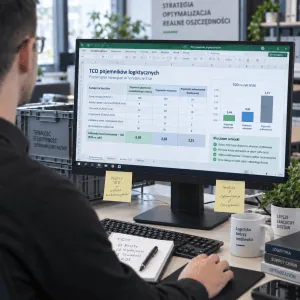
Total annual cost and cumulative cost
The most important outcome of TCO analysis is not a single purchase value. It is the answer to:
what will be the total cost of the solution after several years of use?
Therefore, the calculation shows:
- annual cost,
- cumulative cost,
- the moment of achieving cost advantage.
Why might an imported container be cheaper only on the first invoice?
Choosing a supplier with a lower purchase price is often a natural procurement action.
However, for reusable products, the full lifecycle must be analyzed.
A lower purchase price can result from various factors:
- production costs,
- production scale,
- plant location.
However, the final cost for the enterprise also depends on:
- transport,
- import costs,
- parts availability,
- regeneration capabilities,
- solution durability,
- fleet maintenance costs.
Therefore, the correct question is not:
“Which container can I buy cheapest?”
but:
“Which container will provide the lowest total cost over its entire lifespan?”
European manufacturer vs. import – economic analysis instead of origin assessment
In the discussion about supplier selection, a comparison of European and imported products often arises. However, the production location itself and price should not be the sole criteria. The most important factors are:
- technical parameters,
- durability,
- method of use,
- regeneration capability,
- service availability,
- logistic costs.
Two products with similar purposes can generate completely different costs over their entire lifecycle.
Therefore, the decision should be made based on data, not solely on unit price.

Author: Mariusz Wituszyński
Business Development Director · Elkom Trade
Expert in intralogistics, returnable packaging, and load carriers for manufacturing and industrial companies. Helps companies organize carrier circulation, streamline warehouse processes, and select solutions that combine durability, ergonomics, and real cost optimization.