Back in August, we noted that Black Friday begins in the summer. If you managed to analyze the previous season and evaluate your fleet at that time, this article will serve as a quick review. If not, less than three weeks remain. That is insufficient time for process overhauls, but sufficient to secure the asset most frequently in short supply during peak season: load carriers.
Where does the warehouse lose throughput during the sales peak?
In a standard operating week, a roll container is available precisely where needed. During Black Friday week, the same unit is required simultaneously across order picking, packing stations, loading docks, transport vehicles, retail stores, and the returns area. A mere single-day delay in the return of empty units causes order picking to halt in wait of carriers. Orders are queued, personnel are ready, yet there is nowhere to stage the goods.
Therefore, fleet capacity is calculated for peak demand, not the average, incorporating a buffer for units currently in transit or under maintenance.
Black Friday is merely the beginning
Black Friday is followed by Cyber Monday, then Christmas orders extending until final dispatches before Christmas Eve. The warehouse operates in peak mode for over four weeks, not just a single weekend. In January, gift returns arrive, and the identical fleet must handle the reverse logistics flow.
A roll container procured now therefore operates throughout the entire peak period: from November promotions through the holiday season to January returns.
Three key questions regarding current roll container requirements
- How many roll containers do you require on your peak day, and how many operational units do you currently hold?
- How many of these units will simultaneously be off-site: in transit, across stores, or with carriers?
- Where are empty units staged, and what dock space is lost as a result?
If the initial assessment reveals a shortfall, it must be addressed immediately. In December, amidst peak holiday fulfillment, intervention will be too late.
Empty containers also consume valuable floor space
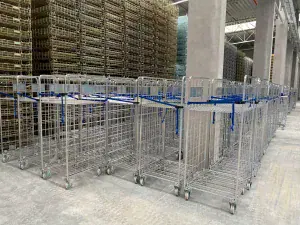
During peak periods, warehouse floor space is as critical as container capacity. A rigid roll container occupies identical space whether loaded or empty. In contrast, a V-nestable roll container folds and nests into adjacent units upon unloading, reducing the footprint of the entire fleet to a fraction of standard storage requirements. The same operational efficiency applies to transport: higher volumes of empty units can be consolidated into single return runs.

Two-sided V-nestable roll container. Available from stock
The two-sided V-nestable roll container is maintained in stock, eliminating production lead times.
- Dimensions: 800 × 704 × 1725 mm
- Load capacity: 500 kg, shelf up to 100 kg
- Weight: 37 kg
- Castors: 4 (2 swivel and 2 fixed)
- Construction: steel, V-nestable
- Finish: electro-galvanized, bright passivation
Key operational applications during peak season:
- Order picking. Functions as a mobile shelving unit operated through warehouse aisles.
- Dispatch staging buffer. Orders are held near loading docks on containers designated by route or store, eliminating loose floor staging.
- Post-holiday returns. Dedicated, labeled containers segmented by status: return to stock, inspection, or repair.
Two side panels retain loads during movement, while open fronts facilitate ergonomic loading. Ideally suited for lightweight, high-volume goods typical of e-commerce fulfillment.
Delivery lead times are critical
In November, equipment procurement is governed by delivery time. Even superior equipment provides no value if delivered after the operational peak. Contact us with your volume requirements, and we will confirm stock availability and lead times.
Black Friday is 3 weeks away. Will you have enough roll containers?
Roll containers available from stock with no manufacturing lead time. Check availability and delivery schedules.


Author: Jolanta Rozwadowska
Key Account Manager · Elkom Trade
Expert in implementing dedicated logistics solutions across diverse industry sectors. For years, she has supported clients across every phase of cooperation, from needs analysis and technical consulting through carrier selection to on-site implementation. She has facilitated the rollout of Elkom Trade containers across international markets, combining in-depth knowledge of operational processes with a practical approach to client requirements.