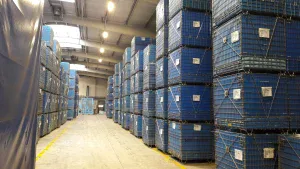
Black Friday doesn’t arrive until late November, but for logistics, purchasing, and operations departments, preparations for the biggest sales peak should begin much earlier.
Summer is a good time to analyze the previous season, check the condition of warehouse equipment, and replenish the fleet of carts and roll containers. In the fall, the ability to respond is already much more limited—especially when there’s a shortage of workers, space, logistic carriers, or properly prepared fulfillment and shipping zones.
That’s why, from a logistics perspective, Black Friday starts in summer?
Black Friday is more than one weekend
Increased warehouse load is not limited to a single day. Promotions often begin in early November and continue through Cyber Monday, the holiday season, Christmas preparations, and year-end sales.
For the warehouse, this means several weeks of work with an increased number of orders. Each one must be:
- picked,
- moved to the packing zone,
- secured,
- handed over for shipping,
- and in some cases also received back as a return.
If the process has not been prepared in advance, the bottleneck may be not only the number of workers, but also the lack of appropriate carts, roll containers, and space for staging orders.

Start with an analysis of the previous season
Before purchasing additional equipment, it’s worth checking what was the biggest problem during the previous sales peak.
The most important questions are:
- What was the maximum daily order volume?
- In which zones did bottlenecks occur?
- Did workers lack order fulfillment carts?
- Did prepared orders block the packing zone?
- How many roll containers remained in transport or stores?
- What did returns handling look like after the holidays?
What portion of the fleet requires repair or replacement?
Only based on this information can you assess whether additional equipment is needed, a change in warehouse organization, or improvement in the circulation of existing carriers.
Calculate equipment for peak, not average sales
One of the more common problems in Q4 is calculating requirements based on standard work volume.
During the Black Friday period, a cart or roll container may be located:
- at fulfillment,
- in the packing zone,
- at the dock,
- in transport,
- in the store,
- in the returns zone,
- in repair.
Therefore, you must account for the entire circulation time of equipment and a safety buffer. Even small delays in the return of roll containers can cause them to be unavailable where they are most needed.
Improve order fulfillment
In e-commerce, one of the most important stages is picking, which is retrieving products from warehouse locations and preparing them for packing.
A poorly chosen cart can increase the number of trips, force additional product staging, and make it difficult to handle multiple orders simultaneously. At higher volumes, each additional action repeated hundreds of times per shift begins to have a real impact on productivity.
Metal order picking cart (available from stock!)
The order picking cart was designed for work in warehouses, distribution centers, and online stores.
The model has dimensions of 1109 × 624 × 1153 mm, a load capacity of 150 kg, and eight shelves that allow you to organize picked products and separate individual orders. Four swivel wheels with a diameter of 100 mm facilitate maneuvering in warehouse aisles.
The cart is also equipped with space for small accessories used during fulfillment, such as a scanner, labels, or auxiliary materials. Bumper rollers reduce the risk of damage to the structure and transported products.
This allows one worker to more efficiently pick multiple orders without having to return repeatedly to the packing station.
The metal order picking cart is currently available from stock.
Organize transport between zones
After fulfillment is complete, the order must be transferred to packing, the shipping buffer, transport, or directly to the store.
Goods placed loosely or on random pallets can block traffic lanes and make it difficult to identify shipments. During peak periods, mobile units work well that can be assigned to a specific order, route, store, or process status.

Check the current number of available units, shipping time, and delivery terms.
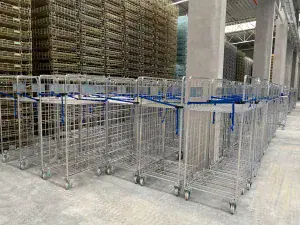
ETV roll container 800 x 704 xh 1725 mm (available from stock!)
The ETV roll container can be used for internal transport, fulfillment, shipment preparation, and distribution of goods to stores.
The model has dimensions of 800 x 704 xh 1725 mm and a load capacity of up to 500 kg. It is equipped with four wheels—two swivel and two fixed—and a foldable V-type structure that allows you to reduce the space occupied by empty units.
The roll container can support, among other things:
- moving products between zones,
- fulfillment of deliveries to stores,
- organization of the shipping buffer,
- handling transfers between locations,
- segregation of returns,
- transport of empty packaging and carriers.
The roll container 800 × 704 × 1725 mm is currently available from stock, so it can be quickly incorporated into preparations before the Q4 season.
Don’t overlook returns handling
The sales peak doesn’t end after the last package is shipped. After the holidays, full-value, damaged, incomplete, or products requiring re-inspection return to the warehouse.
Lack of separate returns organization can cause blocking of zones intended for ongoing fulfillment.
Labeled roll containers can be assigned to different categories, for example:
- product ready for resale,
- product to be inspected,
- damaged packaging,
- incomplete product,
- goods for repair or disposal.
This way, segregation begins at the point of return acceptance, and products don’t end up in one common buffer.

Check the current number of available units, shipping time, and delivery terms.
Q4 logistics preparation step by step
July–August
- analyze data from the previous season,
- estimate maximum volume,
- check the technical condition of equipment,
- count missing carts and roll containers.
August–September
- replenish equipment,
- repair damaged units,
- check the layout of fulfillment and packing zones,
- prepare labeling.
September–October
- conduct a test of increased volume,
- train workers,
- prepare the shipping buffer,
- plan a separate returns zone.
November–December
- monitor equipment availability,
- monitor bottleneck locations,
- shift resources between the most heavily loaded zones.
Black Friday starts before promotions begin
During the peak period, there is no longer time for lengthy testing, repairs, or waiting for additional equipment. The warehouse should enter Q4 with a prepared process, an adequate number of logistic carriers, and a trained team.
At Elkom Trade, we currently have available from stock:
In addition to products available from stock, we also offer a wide portfolio of roll containers, transport carts, and other metal logistic carriers. We can also design and manufacture a solution tailored to a specific process, type of transported goods, warehouse layout, and operational requirements.
Our products can support order fulfillment, transport between zones, organization of shipping buffers, deliveries to stores, and returns handling in e-commerce warehouses, distribution centers, and retail chains.
Contact us to check available models or discuss a solution prepared individually for your warehouse.
Check products available from stock or inquire about roll containers, carts, and logistic carriers tailored to your process.

Author: Kamil Chamerski
Product Manager · Elkom Trade
An expert in the development of products and logistics solutions for manufacturing, industrial, and warehousing companies. He combines client discussions, process analysis, and the design of functional solutions that help optimize logistics, improve work ergonomics, and increase operational efficiency.