Why does the seasonality of the beverage industry affect PET preform manufacturers?
The demand for beverages is not even throughout the year. Reports from companies operating in the European beverage market indicate that sales are usually higher in the second and third quarters, and summer weather can significantly affect order volumes. For PET preform manufacturers, this means a period of greater pressure on timeliness, product availability, and efficient shipping operations. In practice, increased production translates into greater demand for:- containers available directly at production lines,
- space for storing finished preforms,
- efficient flow of carriers between production, warehouse, and customer,
- quick batch identification,
- control of the number of containers remaining outside the plant,
- a reserve of carriers for delays and unplanned orders.
Where do the most common bottlenecks arise during the season?
1. Lack of empty containers at the production line
A container needed at the machine may be in the warehouse, in transit, at the customer’s site, or in a waiting area for inspection. From a production perspective, the total number of containers a company owns does not matter. What matters is the number of carriers actually available at a given moment.
If the fleet was calculated based on average production, not maximum load, it may prove insufficient during the season.
2. Too long rotation time
The full container cycle does not end with delivery to the customer. It also includes:
- waiting for unloading,
- emptying the container,
- preparing it for return,
- return transport,
- acceptance and inspection upon return,
- re-routing to production.
Each additional day of the cycle increases the number of containers needed to maintain production continuity.
3. Occupied warehouse space
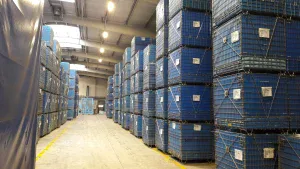
Increased production can quickly reveal warehouse limitations. If carriers are not adapted for stable stacking, a large part of the available hall height remains unused.
Additional space is taken up by pallets, cartons, octabins, dividers, and protective materials. The problem escalates when packaging needs to be folded or prepared immediately before use.
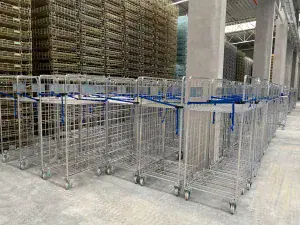
Properly selected mesh containers can be stacked with load, and after emptying, folded and transported in a compact form. For selected designs, stacking up to six levels of loaded containers is standard, and empty containers can be stacked significantly higher. Final parameters should always be confirmed for a specific model, load, and operating conditions.
4. Lack of control over carrier location
During the season, containers move more frequently, making it harder to determine:
- how many are in production,
- how many are waiting for shipment,
- how many are with customers,
- how many are in transit,
- how many require repair or inspection.
Lack of up-to-date data can lead to unnecessary ordering of additional carriers or to discovering a shortage only when the process stops.
5. Damage to preforms during transshipment
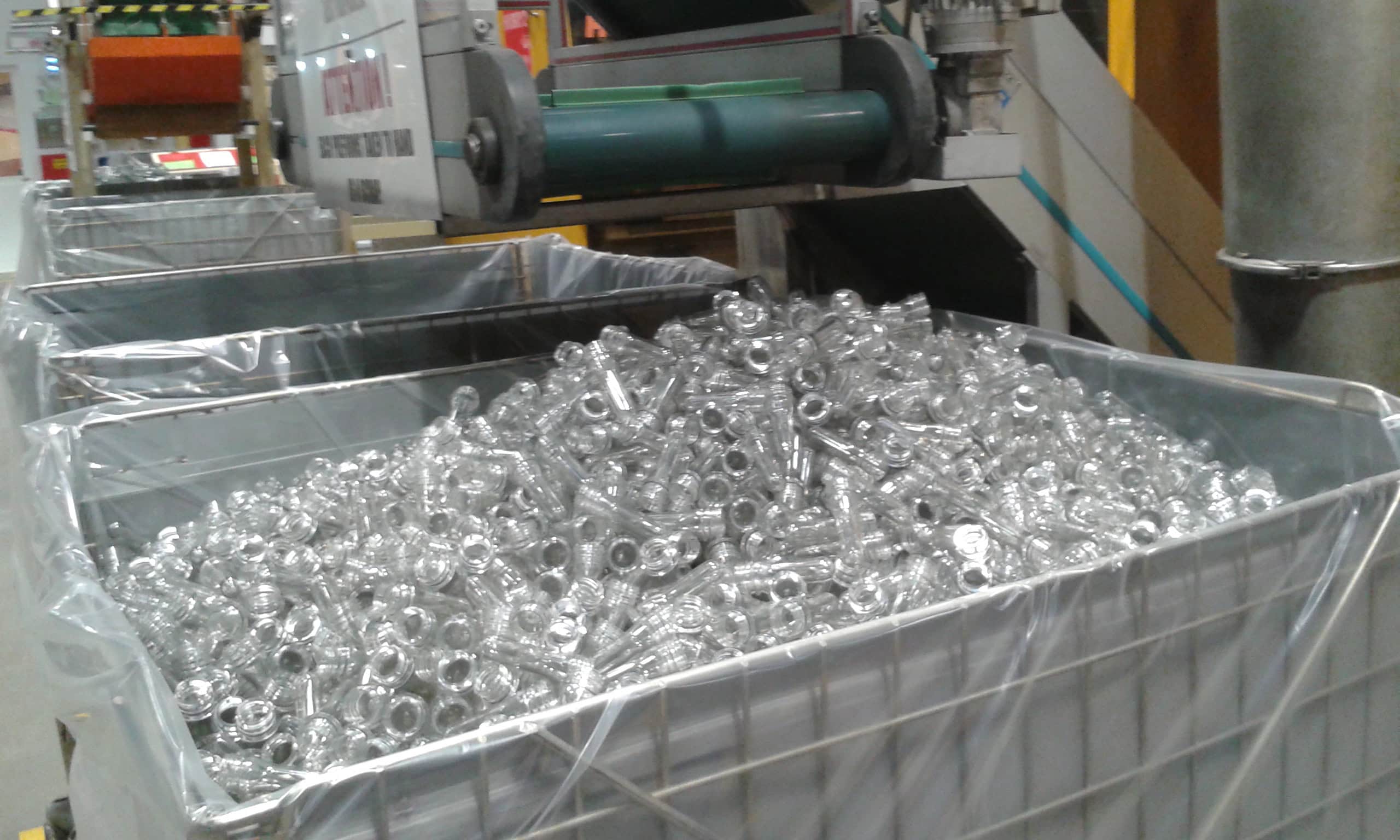
A faster pace of work means more operations performed in a shorter time. Unstable packaging, damaged bases, improper stacking, or incompatibility of the carrier with the tipper can increase the risk of spillage or contamination of preforms.
Therefore, before the season, it is necessary to check not only the number of containers, but also their technical condition and compatibility with the equipment used in the plant.
How to prepare your warehouse and container circulation for the season of increased PET preform production?
Find out how to reduce downtime, lack of space, and carrier shortages.
How to prepare your PET preform warehouse for a period of increased load?
Utilize warehouse height
Area assessment should not be limited to the number of free square meters. The utilization of the hall’s cubic capacity is also important. Stable stacking allows for storing a larger number of preforms on the same floor area. The condition is to select the container according to:- load weight,
- warehouse height,
- floor load capacity,
- forklift handling method,
- fire safety requirements,
- safety rules applicable in the plant.
Standardize carriers
A large number of different container types complicates warehouse organization. Each format may require a different setup, handling, or emptying method. Standardization facilitates:- designating storage locations,
- transport planning,
- tipper operation,
- operator training,
- technical condition control,
- spare parts management,
- return planning.
Designate a buffer zone
A buffer zone protects production from short delays in collection or transport. It should have a defined capacity and a clearly defined function. Without such rules, the buffer easily turns into a temporary warehouse where batches remain longer than planned.Implement batch and carrier identification
Container marking can support control of:- batch number,
- production date,
- preform type,
- quantity,
- customer or shipping direction,
- quality status,
- number of cycles performed,
- inspections and repairs.

What changes do circular economy requirements bring?
From 2025, PET beverage bottles placed on the EU market should contain at least 25% recycled plastic. The target will increase to 30% for all plastic beverage bottles from 2030.
At the same time, the PPWR regulation will become generally applicable from August 12, 2026. The regulatory direction includes, among other things, reducing packaging waste and developing reuse and circular economy systems.
The rPET requirements apply to bottles, not directly to metal preform containers. However, they show a broader change occurring throughout the packaging chain: increasing importance of material control, traceability, waste reduction, and resource reuse.
For preform manufacturers, this means the need to look not only at the product itself, but also at how it is packaged, stored, and transported.
What to do if the season has already started?
It is not always possible to carry out a complete reorganization before production increases. In such a situation, it is worth starting with actions that can bring results in a short time.
Check the actual availability of containers
The number of owned carriers should be distinguished from the number of active carriers. Some may be outside the plant, awaiting repair, or currently unsuitable for use.
Recover containers remaining out of circulation
It is worth analyzing which carriers:
- remain with customers for too long,
- are stored in unused areas,
- are awaiting a technical decision,
- can return to work after minor repair.
Assess regeneration possibility
A damaged container does not always have to be replaced with a new one. If its design allows for safe repair, regeneration can restore the carrier to active circulation.
The assessment should include, among other things, the base, feet, walls, mesh, welds, stacking points, and elements cooperating with automation.
Establish return rules with recipients
Shortening the time containers remain with the customer can be as important as increasing the fleet. It is worth agreeing on:
- the moment of reporting readiness for collection,
- minimum return batch,
- container folding method,
- responsibility for inspection before shipment,
- frequency of return transports.
Checklist
Before the season begins, it’s worth answering a few questions:
- Has the number of containers been calculated for maximum production efficiency?
- How many days does a full carrier cycle last?
- How many containers are currently with customers?
- What percentage of the fleet is out of use?
- Can all containers be stacked safely?
- Is the design compatible with tippers and automation?
- Do empty containers return folded?
- Can each batch be quickly identified?
- Does the company have a safety stock for delays?
- Is there a plan for repairing and regenerating damaged carriers?
How to prepare your warehouse and container circulation for the season of increased PET preform production?
Find out how to reduce downtime, lack of space, and carrier shortages.
A well-prepared season starts with flow analysis
In the PET preform industry, production line efficiency is only one of the elements affecting the timeliness of order fulfillment. Equally important are container availability, warehouse utilization, and the speed of carrier circulation. A properly planned fleet can reduce the risk of downtime, organize the warehouse, and secure production during periods of highest load. This does not always mean the need to purchase a large number of new containers. Sometimes, shortening the cycle, recovering carriers remaining outside the plant, regenerating part of the fleet, or changing the storage method brings better results.Is your container fleet ready for a heavier load?
We will analyze the method of storing and transporting PET preforms, the rotation time of carriers, and their compatibility with the production process. Based on this, we will help determine the number of containers needed and how to organize their circulation. Contact Elkom Trade and tell us about the current flow of preforms in your plant.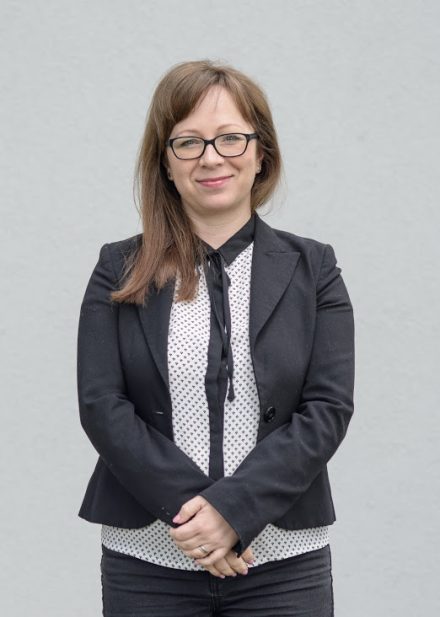
Author: Jolanta Rozwadowska
Key Account Manager · Elkom Trade
An expert in implementing dedicated logistics solutions for various industries. For years, she has supported clients at every stage of cooperation, from needs analysis and consulting, through selecting the appropriate carrier, to implementing the solution at the client's plant. She participated in introducing Elkom Trade containers to many companies in various markets, combining knowledge of operational processes with a practical approach to client needs.