In modern retail, a store is no longer solely a point of sale. It is also a delivery reception point, a local warehouse, an order picking area, an operational backroom, and a place where goods must be moved quickly through several stages every day: from the loading dock, through the stockroom, to the sales floor.
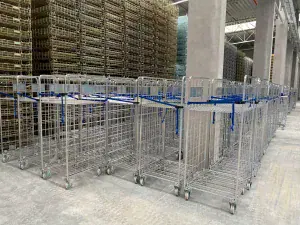
That is precisely why selecting the right logistic carriers is so important. Roll containers, mobile wheeled containers, are one of the most practical solutions for grocery stores, drugstores, industrial retailers, clothing stores, convenience chains, supermarkets, and distribution centers serving retail.
A well-selected roll container is not just a “cart for transporting goods.” It is an element of the entire flow system: from order picking in the central warehouse, through transport, unloading, sorting, product placement, and return of empty units.
According to the Gemius report “E-commerce in Poland 2025,” 78% of respondents declare online shopping in general, and 77% shop in Polish online stores. This shows that consumer expectations regarding product availability, fulfillment speed, and efficient sales channel management remain high in traditional and omnichannel retail as well.
Streamline Deliveries and Store Operations with Elkom Trade
We design and manufacture roll containers tailored to the actual flow of goods, from the loading dock, through the backroom, to the sales floor.

Why are roll containers important in store logistics?
In the retail sector, it is not only important whether goods reach the store. It also matters how quickly they can be received, safely moved, sorted by category, and placed on shelves without disrupting store operations.
In practice, stores face several recurring challenges:
- limited backroom space,
- short delivery windows,
- the need for rapid shelf replenishment,
- employee turnover,
- a large number of product SKUs,
- customer traffic on the sales floor,
- the need to minimize product damage,
- the need to maintain order and workplace safety.
Roll containers address these needs because they enable goods to be transported in a single mobile unit. Instead of repeatedly transferring products from a pallet to a cart, from the cart to the backroom, and then from the backroom to the sales floor, the store can work with a ready-to-use load unit.
This is particularly important where efficiency matters: in grocery stores, drugstores, chains with high product turnover, urban locations, stores with small backrooms, and outlets that receive multiple product categories throughout the day.
Streamline Deliveries and Store Operations with Elkom Trade
We design and manufacture roll containers tailored to the actual flow of goods, from the loading dock, through the backroom, to the sales floor.
From Dock to Shelf: Where Does a Roll Container Actually Improve Operations?
The greatest advantage of a roll container is that it can move through the entire logistics process without changing carriers.
Goods can be picked directly onto a roll container at the distribution center, secured, labeled, transported to the store, unloaded, and directed to a specific zone. This reduces the number of transfers and the risk of errors.
In a store, a roll container is particularly effective at four stages.
1. Receiving Deliveries
When receiving deliveries at a store, speed and order are essential. The vehicle should not block the loading dock longer than necessary, and store employees must quickly sort goods by department or priority.
Roll containers allow goods to be received in an organized form. Separate containers can be assigned to specific categories, such as household chemicals, beverages, dry goods, textiles, seasonal items, or promotional products.
This means employees do not have to start with time-consuming sorting of an entire pallet. They receive goods already in a mobile unit that can be moved directly to the appropriate location.
2. Backroom Operations
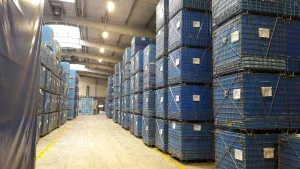
The store backroom is typically one of the most heavily utilized areas in the entire facility. It must accommodate deliveries, returns, packaging, stock, auxiliary materials, and often cleaning equipment as well.
In such an environment, a pallet can be unwieldy. It takes up considerable space, requires a pallet jack, and is not always easy to maneuver in narrow aisles.
A roll container is more mobile. It can be moved, positioned in a traffic lane, temporarily placed by a shelf, or shifted to another zone. Collapsible and nestable models further help reduce the problem of empty carriers after unloading.
This is important for stores where every square meter of backroom space must be used wisely.
3. Placing Goods on the Sales Floor
In many stores, the biggest delays do not occur during delivery itself, but during product placement. Goods must be moved from the backroom to the sales floor, unpacked, assigned to shelves, and at the same time not block customers or create chaos in the aisles.
A roll container allows employees to work directly from a mobile carrier. Goods can be delivered to a specific aisle and then placed on shelves without additional transfers to other carts.
In the case of drugstores, non-food stores, and chains with a large number of smaller products, a roll container with shelves can serve as a mobile picking station. Products are more visible, easier to sort, and less prone to damage than with loose transport.
4. Return of Empty Carriers
Store logistics do not end with unloading. Empty carriers must be collected, organized, and returned to the distribution center or prepared for the next cycle.
This is where collapsible roll containers, nestable models, or those that can be easily stacked inside one another are important. This reduces the space needed to store empty units and improves backroom organization.
For a retail chain, this means greater control over the carrier fleet and less random “clutter” in the store.

What to Consider When Selecting Roll Containers for a Store?
A good roll container should fit the process, not the other way around. Before selecting a specific model, it is worth analyzing several areas.
1. Store Type and Assortment
Different models are needed for food products, household chemicals, textiles, cosmetics, beverages, or seasonal products.
It is worth determining:
- which products will be transported most frequently,
- whether the goods are heavy, light, delicate, or small,
- whether shelves are required,
- whether protection from unauthorized access is needed,
- whether the container will enter the sales floor.
2. Transport Route Within the Store
A roll container operates on a specific route. Most commonly, this is: vehicle – loading dock – backroom – stockroom – sales floor – empty carrier return area.
It is necessary to check:
- door width,
- corridor width,
- floor type,
- thresholds and uneven surfaces,
- freight elevators,
- ramps and inclines,
- locations where the container will be turned or parked.
3. Load Capacity and Stability
Load capacity must match the actual load, but the catalog value alone is not sufficient. It is also important how the weight is distributed in the container and whether the structure remains stable during movement.
For heavy products such as beverages, canned goods, household chemicals, or bulk packaging, a stable structure and quality wheels are particularly important.
4. Collapsibility or Nestability
If the store has limited backroom space, it is worth considering collapsible or nestable models. Empty roll containers then take up less space and are easier to prepare for return transport.
This solution is especially important for chains that manage a large carrier fleet and want to maintain order in circulation between locations.
5. Service and Refurbishment
Roll containers operate intensively. Wheels, shelves, side panels, closures, and structural elements wear out over time.
Therefore, when selecting a supplier, it is worth checking whether they offer not only the sale of new containers, but also spare parts, repairs, and refurbishment. In the long term, this is often more important than the initial purchase.
6. Labeling and Circulation Control
In retail chains, a roll container is part of a fleet. It may circulate between the distribution center, stores, regional warehouses, and suppliers.
Therefore, it is worth providing permanent labeling: plates, labels, barcodes, QR codes, or RFID. This facilitates carrier identification and reduces the problem of lost units.
Roll Containers and Reduction of Product Damage
In retail, losses do not result solely from lack of sales. They also arise from product damage during transport, unloading, backroom handling, or shelf placement.
Roll containers help reduce this problem because goods are transported in a more stable, organized unit. Side panels secure the load, shelves allow products to be separated, and lockable models protect contents from accidental access or movement.
For products in cartons, individual packaging, bottles, shrink-wrapped bundles, or promotional packaging, this is highly significant. A damaged product is not just a cost. It is also a complaint, a waste of time, and additional work for staff.
Roll Containers and Backroom Organization
A store backroom can very quickly become a place of chaos. Deliveries, packaging, products awaiting placement, returns, complaints, and POS materials often compete for the same space.
Roll containers help organize this area. They can serve as mobile zones: a separate container for promotions, one for chemicals, one for dairy, one for returns, one for goods awaiting inspection.
This approach facilitates team management. Employees can more quickly see what needs to be done, where specific goods are located, and which container should go to the sales floor first.
Roll Containers and Omnichannel Logistics
Retail increasingly combines in-store sales with online channels, personal pickups, local orders, and rapid product availability. A store may serve as a point of sale, but also a pickup point, mini-hub, or local warehouse.
In such a model, the flow of goods must be more flexible. Roll containers can support:
- receiving deliveries from the distribution center,
- separating goods by sales channel,
- preparing products for pickup,
- rapid shelf replenishment,
- handling promotional campaigns,
- transfers between stores,
- transport of returns and packaging.
This makes the roll container not only warehouse equipment, but a tool for daily store operations management.
What Distinguishes Elkom Trade’s Approach from Catalog Purchasing?
Purchasing a roll container from a catalog may be sufficient if the need concerns a single, standard application. In the case of store chains, the situation is more complex.
What matters then:
- construction repeatability,
- availability of spare parts,
- ability to standardize the fleet,
- dimension adaptation to the process,
- service,
- refurbishment,
- durability in long-term use,
- ability to produce custom solutions.
Elkom Trade can engage more comprehensively: from process analysis, through structure selection, to fleet delivery and support in its ongoing maintenance.
This is particularly important for companies that are not purchasing a single cart, but building an entire operating system between the distribution center, transport, and stores.
Summary
Roll containers in stores help organize one of the most important processes in retail: the flow of goods from delivery to shelf.
Their role does not end with transport. A well-selected roll container supports unloading, backroom organization, staff work, safety, product placement, return handling, and carrier circulation control.
In the retail, FMCG, drugstore, and non-food sectors, today it is not only the product itself that matters, but the entire logistics process. Therefore, it is worth selecting roll containers that are tailored to the actual working conditions of the store: backroom dimensions, product type, delivery frequency, flooring, ramps, elevators, and product placement methods.
Elkom Trade S.A. supplies metal roll containers and logistics solutions for companies that need durable, repeatable, and practical carriers for daily operations. If you are looking for roll containers for a store, retail chain, distribution center, or warehouse serving retail, it is worth starting with process analysis—not just selecting dimensions from a catalog.
Submit Form
FAQ
In many store processes, yes, but not always. Pallets still work well for large, homogeneous loads. Roll containers are better where mobility, rapid product placement, work in narrow spaces, and reduction of transfers matter.
With proper use, metal carriers can last 10–20 years. Product regeneration (repairs, component replacement, coating refreshment) is usually 60–70% cheaper than purchasing a new carrier.
The most effective are typically stable, maneuverable models, resistant to intensive use and adapted to typical product categories. It is worth considering three-sided models, models with shelves, or collapsible models, depending on the delivery process and backroom organization.
Yes. In drugstores, models with shelves, lockable models, or those enabling separation of small assortments work particularly well. They help organize a large number of products and reduce the risk of damage.
Yes. It is possible to apply markings, plates, codes, labels, or other solutions supporting carrier identification and circulation control.
Not always. In many cases, replacing wheels, repairing side elements, fixing fasteners, or refurbishment is sufficient. That is precisely why it is worth working with a supplier who also offers service and spare parts.