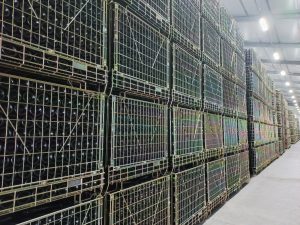
In facilities that blow and fill bottles, the problem often does not arise on the production line itself. It appears between processes.
The bottle has already been blown but has not yet reached the filling stage. It must be collected, temporarily buffered, transported, and then fed back into the line. If this stage is not well organized, deformations, contamination, format mixing, manual handling, and the risk of downtime can occur.
Therefore, the question is not solely: how to store empty bottles?
In practice, a more important question is: how to organize a mobile bottle buffer to maintain fluidity between blowing and filling?
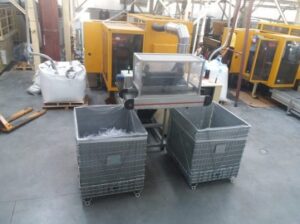
A mobile bottle buffer, also interchangeably used as a bottle container, helps organize the flow of empty bottles, reduce the number of accidental transfers, and protect the product from deformation. We also offer solutions for filled bottles.
Why are empty bottles difficult to store?
An empty bottle is lightweight and therefore requires appropriate handling. Before filling, it lacks the stability it gains once filled with product. It is more susceptible to pressure, crushing, friction, and contamination.
The most common problems arise when:
- bottles are placed on pallets or in random areas of the hall,
- operators manually move or transfer bottles,
- several formats end up in one zone,
- there is no single controlled buffer zone,
- it is difficult to assess how many bottles are ready to be fed into the line,
- the filling line waits for the correct format.
In such a setup, the problem is not solely a lack of space. Often, the problem is a lack of an organized buffer between processes.
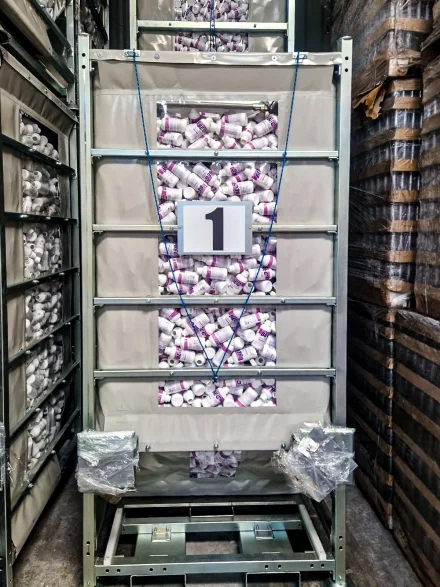
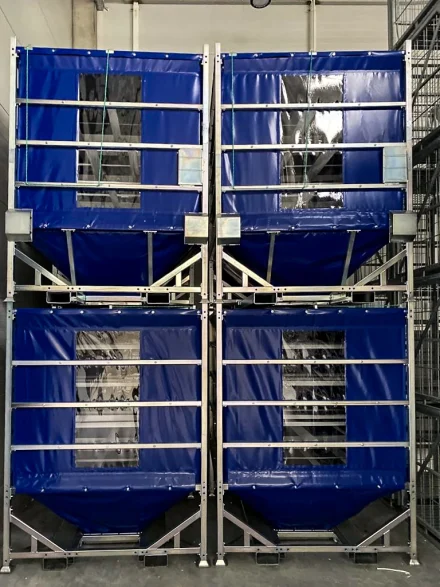
Reduce deformation between blowing and filling
Let's discuss a mobile bottle buffer tailored to your production, bottle geometry, available space, and line operation.
Where does the problem arise? Between the blowing and filling line
Bottle blowing and filling do not always operate at the same pace. Blowing may run in batches, cyclically, or with a different output than the current demand of the filling line. The filling line, however, requires a stable and predictable supply.
If there is no well-designed buffer between these processes, a gap emerges:
blowing produces → bottles go to pallets, big bags, or several storage points → operators manually move them → the filling line waits or operates unevenly.
A mobile bottle buffer precisely addresses this point. Its task is to manage the difference between the pace of bottle production and the pace of their consumption on the line.
What causes empty bottle deformation?
Bottle deformations most often result from several recurring errors:
Excessive pressure on bottles
When stored loosely or in layers that are too high, the bottom levels can be crushed.
Manual transfer and handling
Each additional transfer increases the risk of deformation, contamination, and errors.
Lack of format separation
Mixing different formats can stop the line or necessitate additional sorting.
Random bottle placement areas
Pallets, corridors, and empty sections of the hall quickly turn into an uncontrolled storage area.
Poorly designed emptying
A container that stores bottles well but empties them poorly does not solve the process problem.
Mobile bottle buffer – not storage, but a process element
A mobile bottle buffer should not be treated as a mere storage container. It is a process unit designed to facilitate controlled flow between blowing and filling.
Its purpose is to:
- protect empty bottles from deformation,
- reduce manual handling,
- organize the buffer zone,
- separate the blowing pace from the filling pace,
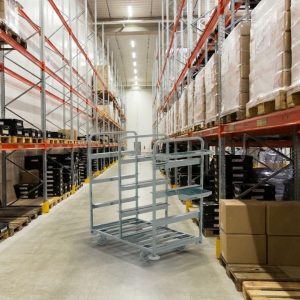
- facilitate internal transport,
- enable controlled emptying to the next stage,
- reduce the risk of format mixing.
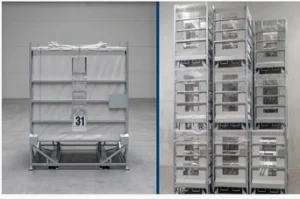
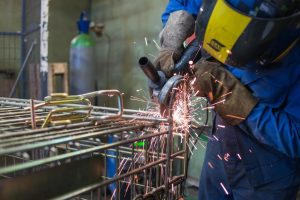
The Elkom Trade mobile bottle buffer is made of steel profiles and PVC tarpaulin, protects bottles from deformation, can cooperate with an autonomous guided vehicle, and allows stacking up to 3 containers high.
Reduce deformation between blowing and filling
Let's discuss a mobile bottle buffer tailored to your production, bottle geometry, available space, and line operation.
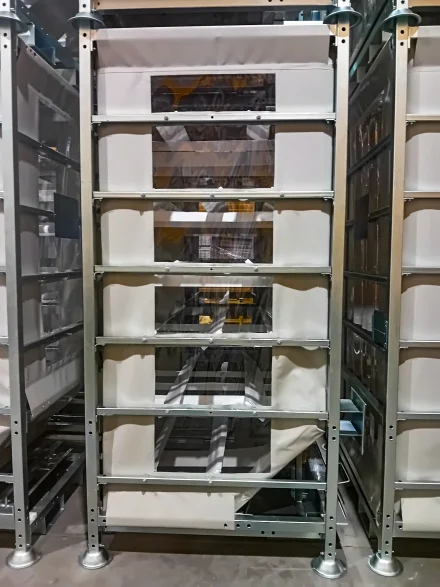
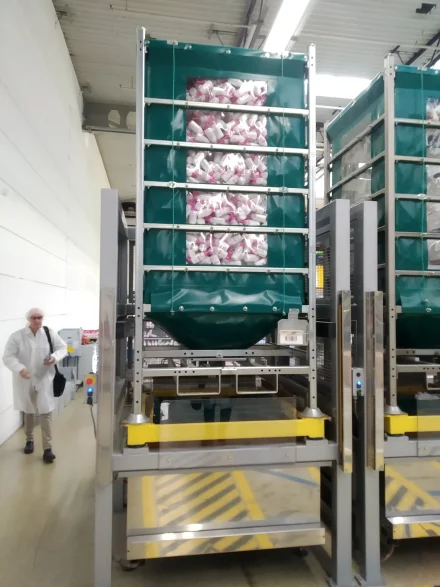
Mobile buffer, silo, or storage system – what to choose?
Various methods for buffering empty bottles are available on the market: from simple drop-off zones, through flexible silos, to integrated storage systems and full line automation. Each solution can make sense, provided it addresses the right problem.
Criterion | Classic Silo Systems / Storage Company | Flexible Silos | Mobile Bottle Buffer / Elkom Trade |
Main Role | Storage and accumulation of empty bottles within a larger line system | Flexible buffering of bottles close to production | Controlled buffer between blowing and filling |
Nature of the Solution | Often more infrastructural and integrated with the line | Mobile or semi-mobile silo system | Mobile unit adapted to the process and hall |
Best Application | Large, permanent buffer points and extensive lines | Bottle production close to the filling line | Critical section: blowing → buffer → filling |
Bottle Protection | Dependent on the system and feeding method | Dependent on bottle geometry and operating method | Stabilizing belts, controlled emptying, deformation reduction |
Implementation | May require greater intervention in the layout | Requires space for silo setup and operation | Can organize a specific zone without rebuilding the entire line |
Operational Effect | Greater accumulation and integration with the line | Flexible stock during production | Less manual handling, fewer accidental placements, better buffer visibility |
The most important thing is not to choose the largest system. The most important thing is to solve the right problem.
If the plant requires full integration with the line, a larger silo system may be the right direction. However, if the problem primarily arises between blowing and filling in the form of deformation, manual handling, format mixing, and a lack of stock visibility, then a mobile bottle buffer is a more practical solution.
When should you consider a mobile bottle buffer?
A mobile buffer/bottle containers should be considered if:
- bottles are placed on pallets or in several areas of the hall,
- operators manually transfer bottles between zones,
- blowing and filling operate at different paces,
- format changes disrupt line operation,
- format mixing occurs,
- empty bottles are deformed,
- it is difficult to determine the actual buffer level,
- the current process relies more on “operator experience” than on a clear standard.
In such situations, a mobile bottle buffer can organize a critical part of the process without the need to rebuild the entire infrastructure.
Mobile Bottle Buffer and Sustainable Production
Sustainable production does not only concern the material from which the bottle is made. It also concerns whether the finished bottle will not be damaged, contaminated, or rejected before filling.
Every deformed bottle means a loss of material, energy, labor time, and process space. A mobile bottle buffer helps reduce these losses by organizing the flow, decreasing the number of transfers, and protecting the product from unnecessary damage.
This is sustainable development in practice: fewer rejects, less chaos, and better utilization of what the plant has already produced.
Reduce deformation between blowing and filling
Let's discuss a mobile bottle buffer tailored to your production, bottle geometry, available space, and line operation.
How does Elkom Trade help organize bottle buffering?
At Elkom Trade, we design solutions tailored to the real process. We don’t start by asking: “which container to choose?” We start by identifying where the problem arises in the flow.
We analyze:
- bottle geometry,
- blowing rhythm,
- filling line demand,
- number of formats,
- available space,
- loading method,
- emptying method,
- internal transport,
- stacking capability.
Based on this, we select or design a mobile bottle buffer, a bottle container, or a system of buffering units adapted to the hall.
Storing empty PET bottles should not be a random stage between blowing and filling. It is a process point where deformations, errors, additional manual labor, and line disruptions can easily occur.
A mobile bottle buffer helps organize this stage. It protects the product, stabilizes the flow, reduces manual handling, and allows for separating the blowing pace from the filling pace.
Submit Form
FAQ
A mobile bottle buffer is a process unit for buffering bottles between blowing and the filling line. Its purpose is to protect bottles, organize flow, and reduce manual labor.
In practice, these terms can be used interchangeably. “Bottle container” describes the structure, while “mobile bottle buffer” better illustrates its function in the process.
Most commonly: excessive pressure, loose storage, manual transfer, lack of format separation, improper transport, and poorly designed emptying.
Not always. In many cases, it organizes one critical point of the process: the space between blowing and filling.
When current solutions cause chaos, manual transfers, deformations, format mixing, or a lack of control over bottle availability.