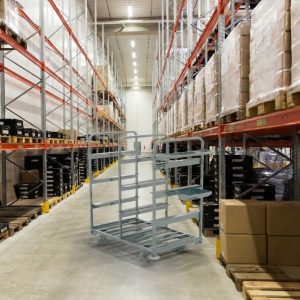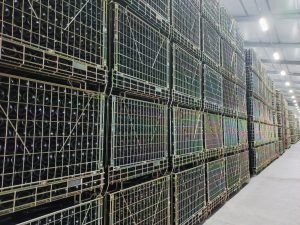
The recycling industry works with difficult, variable, and often unpredictable material. Waste varies in size, weight, contamination level, moisture, susceptibility to damage, and contamination risk. Added to this is the pressure for timely collection, sorting, material recovery, and safe workplace organization.
In practice, recycling is not just about sorting technology. It is also about internal logistics: containers, bins, transport carriers, storage zones, fraction movement, return handling, inter-station transport, and yard organization.
That is why well-selected metal logistics solutions — mesh containers, roll containers, pallet collars, metal pallets, and special constructions — can genuinely support the daily operations of recycling companies.
It is not only about where to “put the waste.” It is about how to maintain order, safety, and smooth material flow from receipt, through sorting, to further raw material transport.
Why is logistics in the recycling industry so demanding?
Europe still generates a very large amount of waste, while not yet recovering a sufficient portion of materials. The European Environment Agency indicates that the EU aims to reduce waste, improve waste management, and keep valuable resources in the economy for as long as possible. The municipal waste recycling rate in the EU reached 49%, but a significant portion of waste still goes to landfills or incineration.
For recycling facilities, this means greater pressure on efficiency. More streams, more fractions, higher quality requirements, and a greater need to control what happens to the material at every stage.
The most common operational challenges are:
- variable composition and quality of input material,
- large number of fractions to sort,
- risk of raw material mixing,
- need to separate clean materials from contaminated ones,
- limited storage space,
- intensive forklift and vehicle traffic,
- manual handling or repackaging,
- damage to bags, cartons, containers, and products,
- maintaining workplace safety,
- pressure for quick collection and further raw material dispatch.
In such an environment, random containers, makeshift storage zones, and non-standard carriers very quickly create chaos.
Do you want to organize material transport and storage in a recycling facility?
Let us discuss metal containers, roll containers, collars, and special solutions tailored to your process.
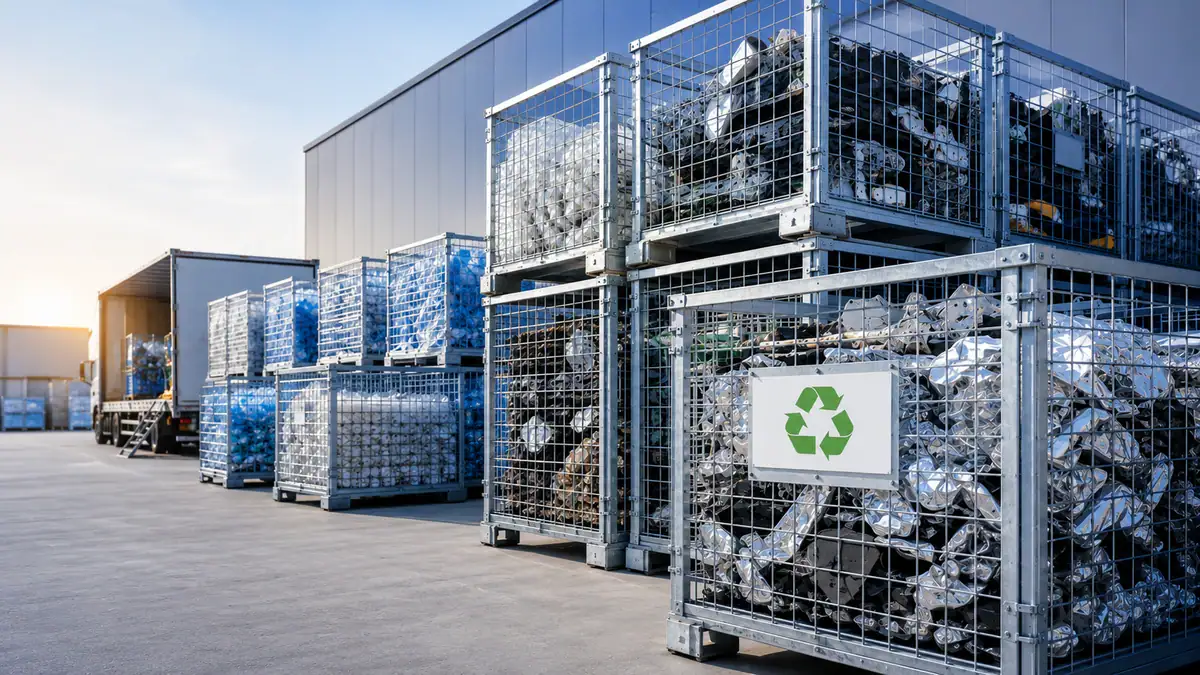
What happens when carriers are not matched to the process?
In recycling, the problem rarely starts with one major error. More often, it is the sum of daily exceptions: material placed in multiple locations, overfilled containers, too much manual repackaging, damaged carriers, lack of fraction separation, or no clear flow path.
In practice, this may mean:
- longer sorting time,
- additional forklift trips,
- blocking of traffic routes,
- fraction contamination,
- damage to recovered material,
- greater accident risk,
- more difficult control of material quantity and quality,
- problems during loading and collection.
HSE, the UK workplace safety authority, indicates that in waste sorting and processing facilities, significant risks include internal transport, vehicle traffic, poor facility layout, slips and trips, manual handling, and fire and machinery hazards.
This shows that carrier logistics is not a secondary issue. It is part of the safety and organization of the entire facility.
Metal mesh containers in recycling – where do they work best?
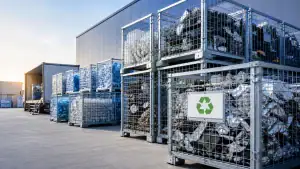
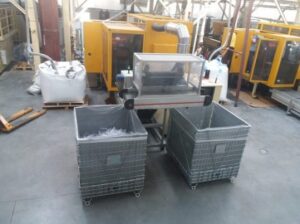
Mesh containers are one of the most versatile solutions for the recycling industry. They work well where material must be visible, easy to move, and safely stored.
They can be used for:
- collecting selected fractions,
- transporting secondary raw materials between stations,
- storing material before further processing,
- separating waste by type,
- storing elements after disassembly,
- transporting parts, packaging, plastics, metals, cartons, or components,
- organizing work zones in the facility.
Their advantage is durable construction, reusability, easy content identification, and resistance to intensive work in a demanding environment.
In the recycling industry, it is particularly important that a container cannot be just a “bin.” It should be an element of flow: material receipt, sorting, buffering, internal transport, storage, collection.
Do you want to organize material transport and storage in a recycling facility?
Let us discuss metal containers, roll containers, collars, and special solutions tailored to your process.
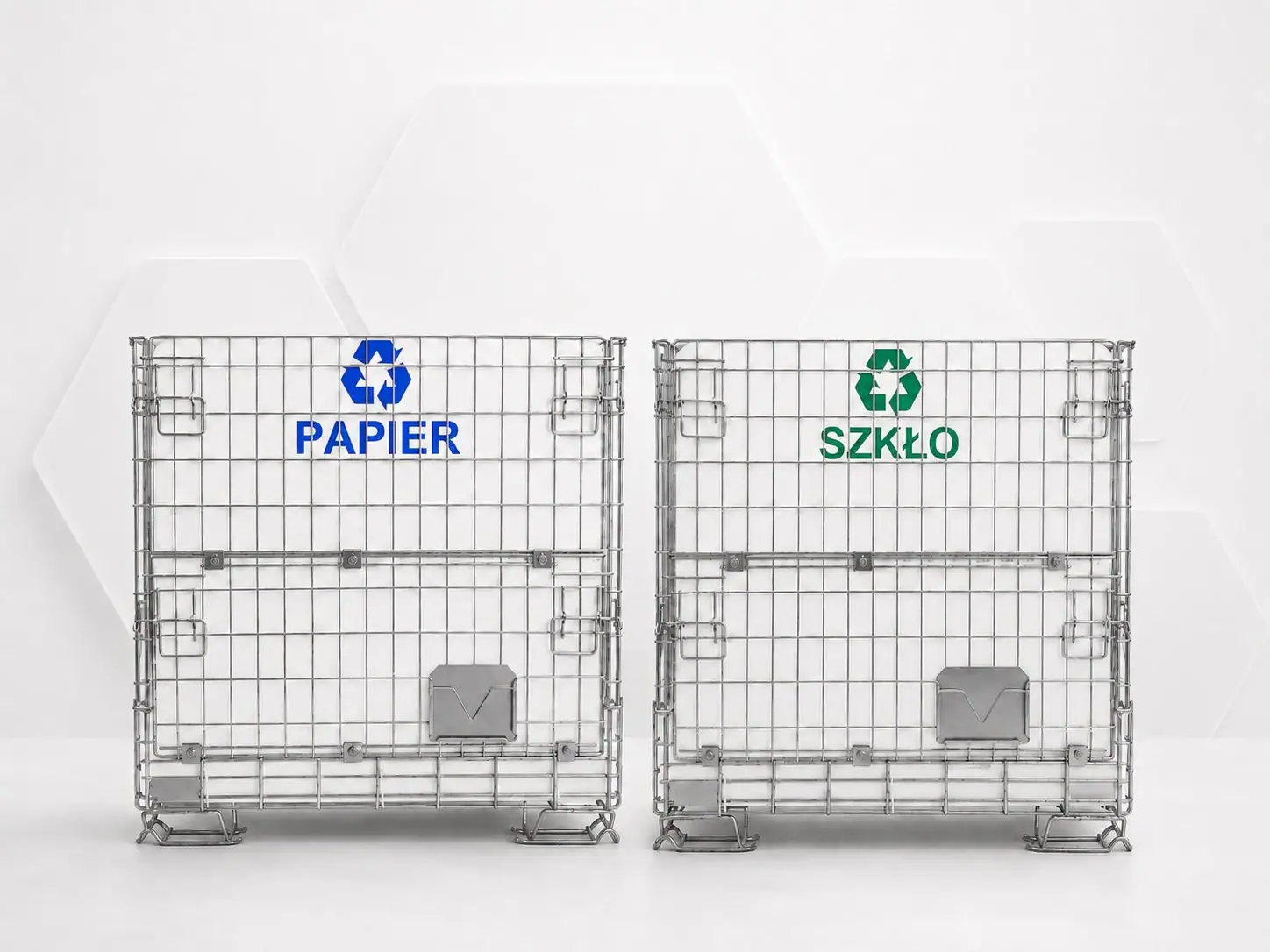
Roll containers, collars, and metal pallets – when do they make sense?
Not every material in recycling should go into the same type of carrier. Depending on the process, a better solution may be a mesh container, roll container, pallet collar, metal pallet, or special construction.
Solution | Where does it work in recycling? | What does it provide operationally? |
Wire Mesh Containers | Visible fractions, disassembled elements, plastics, metals, packaging waste | Content control, durability, stackability, and forklift transport |
Roll Containers | Lighter material, packaging waste, cartons, foils, inter-zone transport | Mobility, easy movement, quick facility handling |
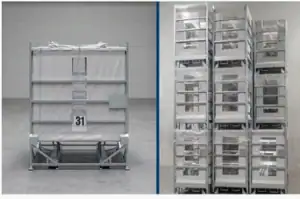
Pallet Collars | Goods or waste on a pallet requiring side protection | Flexibility, foldability, better pallet utilization |
Metal pallets | Heavier loads, industrial elements, internal and external transport | Durability, stability, greater resistance than single-use solutions |
Special constructions | Non-standard waste, specific sorting lines, recurring customer processes | Adaptation to dimensions, weight, loading method, and collection |
The most important thing is that the solution is matched to the material and working method, not just to the available space.
How do metal carriers help reduce chaos in a recycling facility?
In a well-organized facility, every material should have its place, its flow direction, and its handling standard. Metal carriers help organize this.
- Better fraction separation
Containers and bins can be assigned to specific material types. This makes it easier to limit fraction mixing and maintain raw material quality.
- Less manual repackaging
If material goes into the right carrier from the start, the number of transfers between successive stages can be reduced.
- Greater workplace safety
Stable containers reduce the risk of material spillage, passage blocking, and accidental contact with sharp or heavy elements.
- Better space utilization
Containers that can be stacked, folded, or predictably arranged in zones help restore order in the yard and hall.
- Durability in an intensive environment
The recycling industry heavily exploits equipment. Metal constructions better withstand daily impacts, movement, loading, and contact with material of varying structure.
Most common mistakes when choosing containers for recycling
Mistake 1: choosing one container type for everything
Different fractions have different requirements. Foils behave differently than metals, disassembled components, or bulky waste.
Mistake 2: lack of material flow analysis
A container must work throughout the entire process: during loading, transport, storage, and unloading. If it fits only one stage, it will quickly generate problems.
Mistake 3: insufficient construction resistance
In recycling, carriers are exposed to impacts, overloading, contamination, and intensive movement. Too weak a construction quickly falls out of circulation.
Mistake 4: lack of standardization
If each department uses different containers, it is harder to manage space, transport, and returns. Carrier standardization facilitates organization of the entire facility.
Mistake 5: overlooking service and regeneration
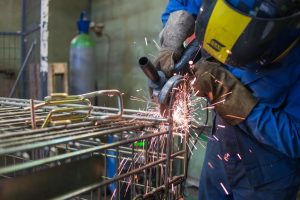
A damaged container does not immediately mean purchasing a new one. In many cases, repair, component replacement, or regeneration makes more sense.
Do you want to organize material transport and storage in a recycling facility?
Let us discuss metal containers, roll containers, collars, and special solutions tailored to your process.
Metal carriers and sustainable development in recycling
The recycling industry itself is part of the circular economy. But that does not mean every process in the facility is automatically sustainable.
What also matters is how the company organizes its own logistics: whether it uses single-use solutions, utilizes durable carriers, repairs its fleet, limits operational waste, and can keep equipment in circulation for years.
Metal containers, roll containers, and collars align with this direction because they:
- are reusable,
- can be repaired and regenerated,
- reduce the need for single-use solutions,
- help organize material flow,
- support segregation and fraction control,
- can enter the appropriate recycling stream at the end of their life cycle.
This is particularly important now, as the EU increasingly emphasizes waste prevention, reuse, and keeping materials in the economy for as long as possible.
When is it worth considering Elkom Trade solutions for recycling?
Metal logistics solutions are worth analyzing particularly when the facility experiences problems such as:
- material is placed in random locations,
- fractions are mixing,
- containers deteriorate quickly,
- the facility loses space due to chaotic storage,
- workers manually repackage material between stages,
- damaged carriers fall out of circulation,
- there is no standard between zones,
- current solutions are not matched to waste weight and type,
- the company wants to reduce single-use or makeshift transport packaging.
In such situations, it is worth viewing carriers not as an equipment cost, but as an element of process organization.
How does Elkom Trade support the recycling industry?
Elkom Trade designs and manufactures metal logistics solutions tailored to real industrial processes. In the recycling industry, this means selecting carriers based on material type, weight, transport method, available space, and workplace safety requirements.
Depending on needs, we can propose:
- mesh containers for fraction storage and transport,
- roll containers for lighter materials and internal transport,
- pallet collars to secure material on pallets,
- metal pallets for heavier loads,
- special constructions for non-standard material or processes,
- service and regeneration of existing fleet.
We do not start by asking: “which container to buy?”.
We start by asking: where in the process does chaos, time loss, or risk occur?
The recycling industry needs solutions that withstand intensive work, help maintain order, and support material separation. Metal mesh containers, roll containers, pallet collars, metal pallets, and special constructions can become an important element of organizing the entire process.
A well-selected carrier is not just a place to put waste. It is a tool that affects safety, material flow, space utilization, and the quality of further recycling.
Submit Form
FAQ
Mesh containers, pallet collars, metal pallets, and special constructions work most often. The choice depends on waste type, weight, transport method, and working conditions.
Yes. Mesh containers can be used for storing and transporting plastics, packaging, disassembled elements, and other fractions that require visibility, separation, and organization.
They are more durable, can be used multiple times, repaired, and regenerated. They help reduce operational waste and better organize material circulation in the facility.
Usually not. The recycling industry works with different materials, so it is worth selecting a carrier for the specific process: one solution for light plastics, another for metals, another for packaging waste or industrial elements.
Not always. In many cases, regeneration, component replacement, or construction repair is possible. This extends the fleet’s life cycle and reduces new carrier purchases.